Kari Granger: He could see so much more, and he said that his meetings, the meetings he
was conducting, all of a sudden, he heard things differently.
He actually started to ask different questions.
Paul Adams: Welcome to Leadership Impact, the podcast for modern executives who are
reinventing leadership within their organizations with your host, executive leadership coach
and CEO of the Granger Network, Kari Granger, and me, Paul Adams, CEO of Sound Financial
Group.
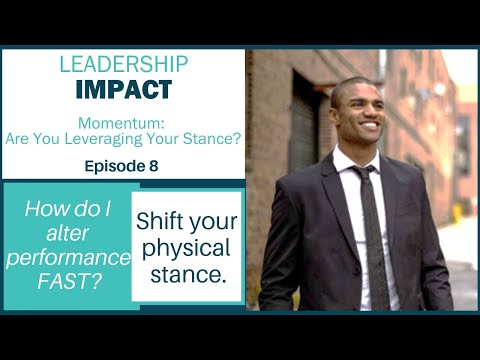
This is episode four of our four-part series on momentum.
Are you leveraging your stance?
Kari Granger: Hey, welcome back to the leadership impact.
I'm Kari Granger, and today's episode is how to intervene in performance by leveraging
your stance.
What the heck does that mean?
Well, a few years ago, I discovered my clients could completely alter the way that they see
their situation, the way that they act, interact with their situation simply by standing differently.
This was huge because I would be on the phone with my clients for an hour and we'd go through
this whole analytical process.
Then I found out, if we just move our bodies in a different way, it'd be like a 5-minute
conversation, and they saw everything they needed to know, everything that they needed
to see.
They saw the actions to take, and they were off and running.
That was huge for me as an executive coach that you can actually intervene in performance
by simply standing differently.
That's what today is about.
I'm joined today by Paul Adams.
Paul, you always bring good stuff for us.
What did you bring today?
Paul Adams: Well, one is small example before I even give the one that I would love some
insight and that we can pull apart for the rest of the episode, but I thought of it during
your intro that there's a gentleman by the name of Sean Stephenson that we had Sound
Financial Bites.
I don't know how long ago the episode was.
I'm sure we can get it in the show notes if anybody wants to hear it, but for the first
time, I was super nervous.
This is a guy that's been on Oprah.
There's a documentary made about him.
Many people have seen the motivational guys that's about three feet tall.
Three-foot-tall giant, I think, was the Discovery Channel biography on him.
I told him, I was like, "You're the first person I've ever interviewed that I felt nervous
about."
He said, "Do me a favor," and he walked me through, literally, some body positions to
take, and gone, gone.
Any agitation, anything that was going on in my body, gone.
That occurred to me in the intro.
The one that I notice a lot is even with my own chief of staff at Sound Financial Group
is that sometimes she is grinding away at an objective and she's trying to get something
done.
I'm wanting to have a conversation with her that's not the task that's not the task right
information front of her.
She is one of the most incredible people.
She eats requests.
Kari Granger: Eats request.
Paul Adams: She eats requests and craps results is what this woman does.
The drawback is I need her insights and knowledge sometimes that aren't about taking the target
right in front of her.
Instead, they're about, I need her not even at 30,000 feet, just get up to 5,000 feet
with me, and it's difficult to do.
When we were prepping for this episode, what I realized is she has a body position over
her computer that's tilted forward, focused in, eyes down that works really well when
she's in certain situations, but I noticed that I can't sometimes get her out of that.
I'm wondering if the physicality piece isn't part of it or couldn't be part of how I can
get her to go to a higher altitude to be in some of the strategic thinking with me.
Kari Granger: Paul, that is such the perfect example.
I just got off a coaching call in which I was working with a colonel in the Air Force,
who had just been promoted to a general officer.
The whole idea of his coaching was to bring about more strategic thinking.
We start looking at just the whole territory of how he operates, what he values, all of
that.
It comes out, I said, "I don't even think you're bought into strategic thinking.
I think this is one of the things you think you have to do."
He goes, "Well, yeah, because I value getting stuff done.
That's what is important here is just get stuff done."
This value, of course, had him focused on the next activity and never taking time for
strategic thinking.
It was really difficult for him to start to shift because for 20 years he had been just
getting stuff done, but now- Paul Adams: For ...
Kari Granger: Oh, go ahead.
Paul Adams: I was just going to say, for our audience, just to give them a sense because
that's a huge rank, somebody who moved ... Just so that they get the kind of responsibility
somebody who's moving from and to, can you give a little bit background on those two
ranks so they get what a big deal the difference is for this guy?
Kari Granger: It's like moving into the executive ranks.
As an equivalent, it might be moving from a regional vice president to a senior vice
president.
Paul Adams: Got it.
Kari Granger: In some companies, maybe even into, yeah, like an executive VP as a one
star, maybe close to the C-suite.
That's kind of a ish.
It's an ish equivalent.
Okay, so this is a big deal.
Paul Adams: It's a big deal.
Like many people who listen to this podcast have never actually ever met a general.
Kari Granger: Oh, yeah.
Yeah.
Paul Adams: Right?
That's the world you swim in every day, but on top of it, that now, the things he was
accomplishing before and the things he's accomplishing now also involve life or death.
I heard a story about an executive that came out of the military ranks at that kind of
rank level, and what he said was, "I decided I wasn't going to be too stressed about business
because nobody was going to die based upon my decisions anymore."
Kari Granger: Right.
Paul Adams: I want our audience to get the consequences you go deeper into the shift
for this guy.
Kari Granger: Yeah, life or death decisions, these guys are making the big strategic moves.
Right?
It's critical that our general officers can think strategically.
This was proving difficult given that this was something that he hadn't practiced most
of his career.
In fact, I find that with a lot of people moving into a higher level strategic position.
We could really talk about it and go through the cognitive analysis of it and all that
for a really long time, but rather ... It just reminded me when you brought up one of
the people that work with you, we worked on his physicality.
When I looked at him, I noticed that he gravitated towards kind of a forward stance, what you
were saying, like leaning over the computer.
His eyes were narrowed.
Right?
His vision was narrowed.
When you're forward in your stance, and you're focused, you're going to get that thing that's
right in front of you done, you don't see the bigger picture because you're posed for
action.
You could imagine the Mission Impossible going song going on, like ... That one, right?
Paul Adams: Mm-hmm (affirmative).
Kari Granger: That is what he look like in his physical disposition.
What we did is we moved his body, and we moved him so that he was rather than being forward,
too forward, and not all the way back, but we moved him so he was kind of standing center.
Right?
He wasn't too forward.
He wasn't too back like he's afraid of the future, but he was really in a neutral place.
A lot of times, if you watch how does the bottom of your feet feel, you'll notice that
you either stand back on your heels or forward on your toes, but we had him so he could actually
feel the long length of the bottom of his foot.
Then we moved his shoulders back so that his chest was really open and wide.
We moved his ... Had his center of gravity down, very stable, like almost as if he was
sitting on a tripod.
We relaxed his jaw, relaxed shoulder, and what he noticed is he simply, by standing
in this different way, he could see so much more, and he said that his meetings, the meetings
he was conducting, all of a sudden, he heard things differently.
He wasn't in his meeting like, "What's the next action?"
He actually started to ask different questions.
Rather than what needs to get done, he'd ask, "What's the bigger outcome that we're trying
to go after here?
What do those people think is going on?"
He started to ask different questions just by standing differently.
I think when you ask, "Could I maybe move, could we maybe even shift the way that my
colleague is interacting with my by shifting her body," I think you can.
Paul Adams: Well, and I'll tell you what I've done just since we floated this idea of this
episode is what I ... It just happened yesterday.
I talked to our chief of staff, and she's getting something done, something critical.
She was posting to our website, something.
She's finishing something up.
I said, "Hey, can we got on a quick walk?"
I get her outside away from her computer, and she's standing.
We're in the sun.
We're walking up and down the street, and her receptiveness to think strategically changes
wildly.
If I don't have her in front of a computer because she defaults inside with her Microsoft
Surface.
That is her tool to get things done.
Kari Granger: Yeah.
Another thing too, one thing that kind of changed my capacity in conversations, this
is something we talked about on our last episode, but conversations that seem intractable, or
ones in which I'm really defending position, another person's defending their position,
or conversations in which I feel attacked is to bring a little bit of malleability into
your posture or flexibility.
One of the institutions that I learned a lot about physicality from, both the Newfield
Network and the Strozzi Institute is they taught me this disposition called flexibility.
It was so easy, but here I am in an argument or I'm feeling threatened or attacked, and
I just tilt my head to the side.
I move my legs, just a little bit of movement in my body, and all of a sudden, I'm totally
receptive and listening in a different way.
It almost generates immediate curiosity when I just kind of tilt my head to the side, like,
"Hmm, what are they talking about," versus, head on, squared ready to attack.
Paul Adams: Yes, I could see that.
I've even seen it in me.
The president of my organization, Cory will often say to me, "I saw," he's talking about
the physicality, he says, "I saw when you were no longer going to have a future of that
person."
I was like, "Why?"
He said, "Because I see the posture you get into when you go from getting things done
with somebody to getting polite."
Kari Granger: Like you've given up on it.
You're just going to polite and let it ... mm-hmm (affirmative).
Paul Adams: Yup.
Yup, we've got some stuff we're going to do together.
That's fine, but I'm not thinking about sharing a future anymore with that person.
Not everybody does that, but I tend to be more focused in a conversation, and so when
he watches me to go more to the care of just being polite, making sure everybody is getting
along, he's like, "Oh, Paul is done here."
He sees the difference in my physicality when I do that.
Kari Granger: Yeah, that's interesting.
Sometimes, I can actually hear the way people are sitting or standing, or in one case, laying
down on the phone.
I've had this one client.
It was like he was stuck, and he couldn't get ... It's all about, what is he creating
his future, and what's the next era of his life.
He was so stuck.
I said, "Just tell me how are you standing or sitting."
He goes, "Oh, I'm not.
I'm laying down."
Oh, well, where are you?
On my bed, in my basement.
It's like dark.
Paul Adams: Yeah.
Kari Granger: You can just hear it in his voice.
Right?
I'm like, "There's something off here.
What's going on over there?"
Right?
Yeah, sometimes, when I do developmental programs, we'll actually teach people different dispositions
so that they can ... Just to empower themselves and to really choose.
I mean, it's not like one is better than the other.
Although there are some really great research about when you're hunched over and concave
that chemicals like cortisol is running through your bloodstream, or when you're in something
called a power stance when you're taking up space, and you're ready to conquer the world.
Right?
Your shoulders are out.
You're in a wide stance, that testosterone, the chemical testosterone will run through
your blood.
We can actually change the chemical make up of our body.
When you're in a stressful situation, a whole bunch of cortisol, maybe that'll be useful
for you if it's a really dangerous, life-threatening situation, but not, for example, if you're
giving a presentation to the board or something like that, right, in which case, it'd be much
better to have a different chemical make up in your body.
What I was going to say is working with people in the leadership development program where
we teach them different ways of holding themselves.
I had one woman who ... Maybe I've talked about her on a previous episode, I can't remember,
but the breakthrough for her in actually being able to bring the appropriate amount of intensity
and anger when, really, anger was a good emotion to use.
She never had access to it before.
Well, how she got access to it was simply using a different body stance.
When she could access anger as an intentional tool, when it was appropriate, as contrasted
with appeasement and when anger was really appropriate, but she got there through altering
her physical stance.
Paul Adams: Many of our listeners today, one ... I always try to give at least one or two
things people could practice or try this week based upon the topic.
Kari Granger: Oh, I have one.
I'm interrupting you.
Paul Adams: Please.
Kari Granger: I so want to give this one.
Okay, so here's what I do, and I found that this is really useful for my client.
I'm a public speaker, and I love public speaking.
I kind of suffer a little beforehand, like getting it all right, and is it going to go
well?
When I get out, when I get out on stage, really, and I love speaking to thousand-plus audiences,
but I get nervous.
I totally get nervous, even though I love it, I get nervous.
I used the practice of centering.
It doesn't have to be that kind of environment.
It could be any environment in which I need to give myself some power and capacity, and
so I do a practice of centering.
Do you think that would be a good one to share?
Paul Adams: Yeah, fire away.
Kari Granger: Okay.
Good.
The first thing I do is I take three deep powerful breaths, like really feel my breaths
fill my body, like aware, just aware of my breath.
Okay?
When I exhale, I allow my exhale to take twice as long as my inhale.
Okay?
My focus is on my breath.
I noticed that I actually have a body.
Okay?
Some of us walk around in life, really, only aware of our head.
It's like we're only aware of our head floating through life, right?
I take a moment and be like, "Oh, yeah, that's right.
I do have a body.
I have legs.
I have arms.
I could feel that."
Right?"
Then I center in three directions.
This also came Richard Strozzi-Heckler.
I center in length.
I make myself as long as I can, like pulling the top of my head up while the bottom of
my feet are going down.
I extend my length.
By the way, this is the direction of dignity, so I really extend my length.
Then I extend the side to side, my width, and width is about belonging.
It's about connection with others.
I get wide.
Right?
I think about myself, height.
I think about my width.
I take up space, and I don't apologize for it.
Right?
Not in an arrogant way, but I'm here.
I'm here.
I'm taking up this space.
Then I find my depth, so front to back, and this is our relationship to time.
I just imagine opening and moving front to back, so then I find my height, my width,
and my depth.
When I stand like that, it gives me enormous presence and capacity to deal with anything
that's coming my way.
I think the practice of centering, of noticing my breath, my body, and then my length, my
width, and my depth would be a great practice for us just to see what happens when you stand
that way.
Paul Adams: Kari, that is great, and the idea of my stance in making sure that I'm ready
for the situation at hand, but how do I go about when I see somebody else, where their
stance is not going to allow them to hear the situation or the conversation or the direction
I want them to go, it's evident that their stance isn't going to allow it, how can I
move somebody from their existing stance to a new stance that would allow them to be open
to the task at hand?
Kari Granger: Yeah, it depends on your relationship with that person, right?
If you have permission to support them in their performance, kind of like a coaching
permission, for example, you can simply say, "Hey, why don't you try to move your shoulders
back, open it up a little bit, so you can actually ..." if you have that permission.
A lot of times, we don't have that permission.
One thing you can do is say, "Hey, do you mind walking with me for a moment," so walking,
just getting people actually in a different position.
Sometimes, I'll ask somebody, "Hey, could you grab us a couple glasses of water?"
That just moves them.
Right?
Also, if you lead a team, one of the best practices is actually to start meetings by
centering.
I've seen this with leadership teams before where the team leader will say, "Okay," everybody
is coming in.
They're chaotic.
They got different moods.
They got all these different things on their plate.
They look like they're in the middle of a crazy day.
They'll just say, "Okay, let's take a second.
Let's center in three directions, length, width, breath."
You have to introduce it the first time.
The first time, it might seem a little weird, but as it becomes a practice, it's extraordinary
how it just brings everybody into focus.
It calms the energy down, and people are present and ready to go to work.
There's this crazy thing, Paul.
I do these six 12-month leadership programs, and I will provide so much content, new models,
new perspectives, all these tools, and I'll spend, I don't know, 10 minutes in the very
beginning on centering.
When I ask people throughout the time, what tools, what perspectives are you using the
most, do you know what they say?
Centering, because I think it's so practical.
It's so easy, and they're doing it with their teams.
Paul Adams: Well, what shows up for me, it's easy, it's practical, and it's almost a direct
correlation to an increase in performance for later.
Kari Granger: It really is.
Paul Adams: I'm often thinking as we go through this podcast what are the things people could
take away that they can implement today so they're driving, listening to this podcast
on their way into the office is that idea of just pausing for, what, 30 seconds, a minute
ahead of time, centering themselves physically, and then mentally for whatever the next meeting
might be rather than what we tend to do is jump right from one to the other.
Invest that 30 seconds or a minute to get yourself centered.
Be self-centered today.
That is the message.
If you are a centered self today, you can be more effective in your leadership impact.
Thank you, again, Kari, and to the entire Granger Network for being able to help put
this podcast out and get these kind of both deep philosophical thinking and yet practical
tips that people can use today for their leadership impact.
Kari Granger: Thanks, Paul.
Paul Adams: Thank you for tuning into Leadership Impact, the podcast for modern executives
who are reinventing leadership within their organizations.
Subscribe now at grangernetwork.com or wherever you get your podcast.
To support you in your leadership impact, we've created an exclusive set of guiding
questions on today's topic.
Just text the word physicality to 900900 and you'll receive the link.
We also have some special offers for you.
Between now and the end of 2018, you can register for our upcoming productivity and accomplishment
workshop for 25% off, or any of Kari's online courses for 50% off with the coupon code celebrate,
as we celebrate our launch at grangernetwork.com.
Join us for our next episode on new futures.


 For more infomation >> What you need to know before returning gifts this holiday season - Duration: 2:10.



Không có nhận xét nào:
Đăng nhận xét