Welcome back to the Gentleman's Gazette!
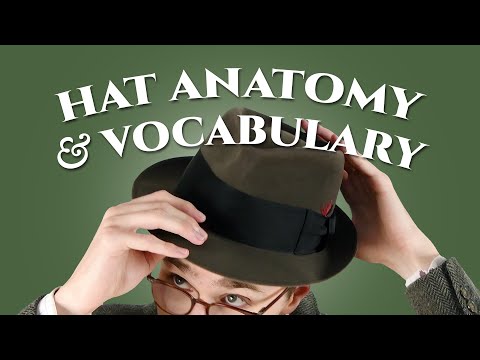
In today's video, we'll be discussing the key vocabulary for traditional men's hats,
common shapes and styles, and traditional construction materials.
Loyal viewers of the channel will be aware that in the past, we've put out four previous
videos on hats guides to the fedora, the flat cap, the Panama hat, and also a general guide
on how to find the right hat for your specific face shape.
You might also be wondering about other information regarding hats like some of the other popular
styles that are out there, the vocabulary terms surrounding hats, or the proper etiquette
for wearing a hat; well if that's the case, you're in luck because we're starting another
series on hats and the first video in that series is going to cover key vocabulary.
One caveat for this series, there are of course all kinds of hats out there that have been
developed throughout history, everything from the tricorne to the pith helmet, to the modern
baseball cap, for these videos, however, we're just going to concern ourselves with hats
of the 19th and 20th centuries.
Although some of the more general terminology we'll cover is applicable to a broad range
of hat styles, some of them outside of the hats we're specifically going to cover.
With that said, let's dive into today's topic, the anatomy of the hat starting with basic
vocabulary.
We'll start from the top of the hat and work downward beginning with the pinch, also known
as the crease.
The pinch or crease refers to the indentations made along the front, back, and sides of the
hat in conjunction with the overall crown shape.
By the way, we'll cover different crown shapes in a moment.
One tip related to this specific part of the hat, don't handle your hats by the crease.
It seems natural to do this because of the way that it fits into the hand but if you
handle your hats by the crease often, your hands are eventually going to leave oil on
the surface of the hat and that might stain it so it's best to always carry your hat by
the brim.
Next, we'll cover the crown.
As you might guess, refers to the central body of the hat.
The part that extends upward covering the head.
In most cases, the natural shape of a hat's crown is a dome, although exceptions do exist
such as the straw boater, through a process called blocking where water and steam is applied
to the surface of a hat, it can be shaped into any number of different crown configurations
which as I said, we'll get to in just a moment.
While water and steam are applied to the crown to shape it, it's also stretched over a pre-existing
form usually made of wood or metal.
This is how the hat can hold its shape after it dries.
One other note here, the uppermost peak of the crown is sometimes referred to as the
tip.
Next is the Hat band which is the strip of decorative material encircling the crown positioned
just above the brim.
It's most often made from a ribbon which can feature a bow or a series of decorative folds,
a leather strip, or a piece of braided cord which can sometimes feature tassels.
The Hat band is also sometimes accented further by a decorative pin or a feather.
Next is the brim which as you may have guessed is the horizontal ledge protruding from the
bottom of the hat and extending outward providing shade and protection from the elements for
the wearer.
The width and style of the brim in conjunction with the shape of the crown are the two things
that most directly contribute to a hat's overall type or classification.
The shape and curvature of the brim from front to back and from side to side is sometimes
collectively referred to as the flange of a hat.
Another style tip here, while it's a good idea to carry your hat and take it on and
off by use of the brim, don't store your hat sitting on its brim when you're not wearing
it.
If you do this, the brim can lose its shape over time so the best course of action when
you set your hat down is to place it upside down so that it's resting on the top of the
crown.
Alternatively, you can keep your hats on a hat rack, this way, you don't have to worry
about brim or the crown losing their shapes over time.
One other note related somewhat to storing your hats, when it comes to cleaning, you
should occasionally brush your hats with a hat brush to make sure that they don't accumulate
dust or any other sorts of particles.
Two more terms related to the brim, the first of these is the under brim which simply enough
just refers to the underside of the brim, that's all there is to it.
The second of these terms is the brim binding or edging which refers to the specific styling
around the outermost edge of the hat's brim.
The edging can be done in any number of ways; you can have a raw cut edge, a sewn edge,
a ribbon edge, a leather banded edge, or a hand felted edge which is also known as a
Cavanagh edge.
Next is the lining or liner tipping.
The optional piece of fabric on the inside of a hat usually made from cotton or silk,
though sometimes made from velvet that will feature the hat maker's trademark most of
the time.
For estate hats which is to say, vintage pre owned hats, or for hats that are yours that
have seen a considerable amount of wear, you may occasionally want to clean the inner lining.
This can be done with a little bit of soap and water.
Alternatively, you can just remove the inner lining as I've done with many of my own personal
hats.
The sweatband or inner band is a strip just inside the crown that keeps the hat better
fitted to the wearer's head and also diverts perspiration.
It's most typically made of leather for felt hats and made of fabric for straw hats.
One tip here, if you flip the sweatband inside out when you're storing your hats, which again
should be done upside down, that will help the sweatband to air out so that perspiration
or hair product don't accumulate there over time.
Next, let's cover a few vocabulary terms that refer more to general classifications than
specific parts of a hat's anatomy.
We'll start with the term snap brim which simply refers to a brim that can be snapped
or turned on different parts.
Usually, it's done in the front and left up in the back.
This is a common feature for fedoras and trilbies in particular.
The term stingy brim describes a hat with a very short brim usually of about one to
two inches and the term can also be considered a style of hat in its own right though you
won't necessarily see that done too often.
You might sometimes see hats described as being packable or crushable.
A common misconception about this term is that the hat can be really beaten up, totally
scrunched down into a ball and that it will perfectly reform itself once you take it out
and shape it a little bit.
That isn't necessarily true, while hats marked as packable or crushable can generally receive
a little bit more abuse than their stiff counterparts, it's still best to treat them with care and
they may need a little bit of steam and water if they're really out of shape.
The term shapeable applies to hats that have a metal wire sewn inside of their brims.
Some hats come with plastic wires sewn inside the brims and these generally hold their shape
whereas the metal is a little bit more malleable so you can style the brim in a number of very
specific ways.
Next, let's talk about UPF or more generally, sun protection from hats.
Not to be confused with SPF, the term UPF stands for ultraviolet protection factor.
This classification takes into consideration a few factors such as the weave, color, weight,
and stretch of a hat and most often, hats with the UPF designation are also coated with
a bit of ultraviolet protective agent.
There are also specific UPF ratings which are as follows; a rating anywhere from 15
to 24, the Hat will have an ultraviolet protection percentage of about 93 to 96 percent, a UPF
rating anywhere from 25 to 39 and the hat will have a protection percentage of 96 to
about 97 and a half percent, and finally, a UPF rating from 40 to anywhere above 50
will provide ultraviolet protection percentage of about ninety seven and a half percent to
just over 99%.
As you may be aware, brimmed hats are often distinguished by the shapes of their crowns.
The teardrop or C crown shape either looks like a teardrop if you are considering the
entirety of the hat or like a letter C if you're looking primarily at the back portion
of the crown.
The center crease or center dent style typically features one central crease that runs down
the middle of the crown typically at a depth of about one to two inches.
The diamond crown is a slightly less popular shape than the more commonly seen teardrop
but it was a popular style for a time in the 1940s and it's a little bit wider than your
typical C crown shape.
Next is the flat top or telescope which is typically seen on everything from top hats
to Gambler hats, straw boaters, and porkpie hats.
This crown shape either features a totally flat top crown or a slight lip that runs around
the perimeter of the crown at a very small depth.
Finally, there's the open or round crown which simply refers to the natural shape of the
crown before it's shaped into a different style.
Also, the crown can be left round for some styles such as the bowler or derby hat.
Finally today let's cover an overview of the most common construction materials for traditional
men's hats.
Cotton hats are usually quite durable and also sometimes packable or crushable and they're
typically on the softer side as compared to some other construction materials.
One of the most common construction materials for traditional men's hats is wool felt which
is crafted by pressing together wool fibers and applying heat and moisture which makes
the fibers matte together into a cohesive surface.
Like cotton, wool felt is soft and can come in just about any color.
Fur felt is created in the same manner as wool felt but typically in finer and often
even softer materials.
Most often from beaver or rabbit pelts.
Fur felt is noticeably softer to the touch than wool felt and as such, you can expect
to pay a higher price for the increase in quality and luxury.
Next up is straw.
There are great many varieties of straw used to make hats which vary slightly in strength,
durability, and color.
For example, raffia is a straw used to make many packable and crushable hats whereas straw
coming from the toquilla palm is commonly used in the construction of Panama hats which
we've discussed before.
Most any type of straw can theoretically be woven into a hat but higher quality selections
are typically handpicked for their evenness in color, texture, and pattern.
Polyester is a less commonly used material for hats or at least for hats of quality but
it is out there.
Our final material today is Toyo or paper braid.
As the name suggests, these hats are made from strips of paper that are woven together
similarly to straw and then formed into the desired shape.
These hats have been increasing in popularity in recent years due to their low cost and
relative durability although they're not quite as durable as straw.
So now that you're aware of all of the various terms and materials that go into making traditional
men's hats, you'll be better equipped to go out and find a style that suits you best.
As a reminder, you can check out our previous videos on hats here and don't forget to stay
tuned for the remaining two parts in this series.
We'd like to know if you wear hats regularly, what styles do you prefer?
Share with us in the comments section below!
in today's video I'm wearing a herringbone sport coat it's charcoal gray but also features
elements of black white and even a hint of brown my shirt which is from Charles Tyrwhitt
features a grid pattern of pink and blue on a white background most of the other elements
in my wardrobe today are from Fort Belvedere and we'll start with the tie which is a silk
knit tie in mottled blue and brown the blue of course harmonizes with the blue in my shirt
and the brown is dark enough that it still remains harmonious with most of the other
elements of the outfit as well as bringing out some of those subtle brown tones in the
sport coat the pocket square is a dark blue linen featuring a white hand-rolled X stitch
and the boutonniere is a light blue Veronica persica my final Fort Belvedere accessory
today are my cufflinks which are palladium plated sterling silver and feature lapis lazuli
as the stone you can find all of these Fort Belvedere accessories in our shop here my
trousers are plain black as are my socks and my shoes are cap toe black derbys and of course
today's outfit is topped off by a hat it's a vintage charcoal gray trilby you could also
perhaps call it a stingy brim Fedora since the band is relatively wide and the style
kind of sits between both of these I thought this hat would be a good
choice not only because the color directly corresponds to the color of the sport coat
but also given the sporting heritage of the trilby I thought the Hat would pair well with
the thick tweed of the coat as well as the knit of the tie




Không có nhận xét nào:
Đăng nhận xét