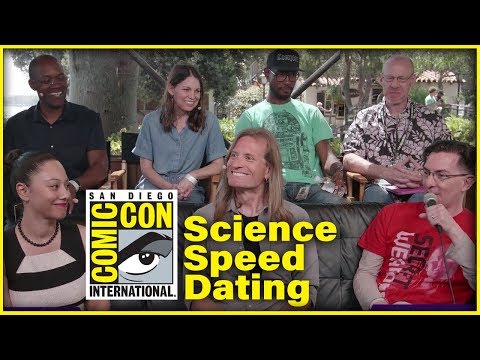
- Hello and welcome to Science Speed Dating.
I'm your host Eric Heisserer, screenwriter of Arrival
and writer of the comic book Secret Weapons.
If you have opinions about either of those
and want to see me face-to-face,
I am currently up for auction at charitybuzz.com
so go over there and bid.
If you win then I'll take us to lunch
and you can criticize my moderation of this event
for an hour if you like.
So let's talk about Science Speed Dating.
This is a made possible by Science & Entertainment Exchange,
which is a program for the National Academy of Sciences.
I would not try to say that fast
and the way this goes is
each of these six geniuses here with me
have exactly four minutes to blow your mind with science
and then after that we will open up to general questions
and then we'll we'll be off to the races
and there may be Mario Kart races.
So let's start this with our first speaker,
Clifford V. Johnson, Professor of Astronomy and Physics,
was it?
- Physics, USC.
- USC, all right.
Your four minutes start now Clifford.
- Well hi, I thought it'd be fun to give you 10 things
that you should know about black holes.
So you should maybe take that to the pub
and impress your friends in conversations.
So you hear about black holes a lot,
but what are they and you know when do they come about?
First of all, they weren't invented by Stephen Hawking
as people often say, they actually were invented
or discovered, the idea came a lot earlier.
Actually in the 19th century a teacher called Michell,
John Michell had the idea.
He was thinking about the fact that,
as it has been recently discovered,
light travels at a finite speed
and he thought what if the escape velocity,
how fast you need to get a rocket off a planet or something,
what if that escape velocity was the speed of light?
Then it wouldn't be able to escape
and you would have what he thought of
as what he called a black or dark star.
The term black hole came later.
So that's the context.
It's an old idea,
but then it actually made a lot of sense
much later on by about 1915
when Einstein had helped us figure out
what gravity really was
and it was fabric of space and time itself.
It's this sort of flexible thing that can change and stretch
and all those ideas you've heard about warp drive
and what-have-you are inspired by that sort of idea.
The shape of space and time changing.
It turns out that within a few months of
Einstein writing down his final equations,
which are really, really difficult equations to solve,
in the trenches in World War I in his spare time
a young guy called Karl Schwarzschild
actually figured out the first
non-trivial solution of Einstein's equations.
Turns out that that, the Schwarzschild solution,
is the thing that eventually we recognized
as also describing a black hole.
So that was 1916.
So then you go a little bit further and what's going on?
Well people are going well yeah,
is it just some crazy solution that isn't real?
Is this really physics?
It's so extreme, it's so crazy, this object,
that people took a long time to actually appreciate
whether it really existed.
Turns out nature really makes them.
We now know that.
People realized actually that stars like our Sun
or actually a little bit bigger than our Sun
and anything much bigger than that,
eventually they run out of the fuel
that they burn in order to stay
actually these big bright objects that we that we know,
they run out of that fuel
and then there's a lot of stuff left over
that then collapses under gravity
and becomes so compressed that the escape velocity
is the speed of light and a black hole forms.
It turns out black holes
are showing up everywhere in the universe now
where we're understanding astrophysics.
The center of nearly every galaxy
has a supermassive black hole,
hundreds of millions of times the mass of our Sun.
Those may be not just decoration,
they may be crucial to how galaxies form, how they evolve.
So we're learning so much about the fate of our universe
and everything in it is governed
by the influence of black holes in interesting ways.
Most recently you may have heard in the news
about colliding black holes.
There's an experiment called LIGO
where you receive gravitational waves,
which are ripple in that flexible space in time
that Einstein discovered.
Ripples coming out from the explosion
created by two black holes colliding.
So that's another amazing place we're beginning to see that
black holes are everywhere we look
in various interesting ways
crucial to how astrophysics works.
And finally, actually as Hawking discovered
black holes actually aren't black.
When you start mixing them with quantum physics,
we're learning so much about how much changes
when you add that.
It turns out the black holes leak out radiation
due to quantum effects in a very interesting way
and the whole field of quantum gravity,
which is what I work on, uses that
and many more things to explore how black holes really work.
- Wow Clifford, you're right there under the wire.
(laughing)
I don't think you could be that more accurate
if you were in a black hole.
(laughing)
Next up is a Director for analytical development
at a pharmaceutical company, it's Jaime Marach.
- Hi everybody, a pleasure to be here today.
I'm going to talk to you about the medical field
and we have an image on the screen with me today I think
for my topic, for your enjoyment.
What I really want to start with is
I hope they get all the cancer out.
And this is really what every patient says
when they finish their surgery to remove their cancer
and so I'm going to talk about this cancer detecting pen
and it's called the MasSpec Pen
and it was invented by a group
at the University of Texas at Austin
and I'm really excited about it.
This is the future of healthcare to me
and this cancer detecting pen
can help with tumor removal
while the patient is on the operating table.
And it can help the surgeon make decisions in seconds
in real time during the surgery.
And so thinking of how common cancer is,
this pen has the ability to
affect millions of people's lives.
And so it's been in the news, maybe you guys have seen it,
but what's the current problem that this pen
is trying to solve?
It's that cancer patients, like we said,
they undergo a surgical treatment to remove their tumors,
the surgeon will attempt to remove
all of the cancerous tissue
while leaving as much of the healthy tissue behind.
You remove not enough tissue,
the patient is back for surgery again.
It's more anesthesia, cost, time, pain, recovery.
If you remove too much you may end up with more
disfiguring aesthetics with what's remaining behind
so this is just a really important area.
And so to assess currently how much tumor to remove
by the surgeon they take tissue slices.
They remove slices from the body or pieces of tissue
and they send them off to a separate lab frozen
and they analyze them there.
Meanwhile the patient is left on the operating table
for 30 minutes or more open while these samples are analyzed
and decisions are made and a lot of times the result is
not all of the tumor is removed.
So this is why this is just really exciting.
So the solution to this problem, this MasSpec Pen,
it works like a barcode reader for cancer.
So they will take this pen and actually touch it
to the open patient in the operating room.
It's non-destructive, you just hold the tip
up to the tumor and it will actually read
the sort of biomarker unique profile of that tumor
and the software will read out
cancer, you should take more out,
or healthy cells, you can stop here and move on
and test the the next area.
So it really helps with looking at the margins of the tumors
and in the image that you guys are sharing with me,
you're seeing a tumor that is removed from the body
in the lab.
It can be used for that traditional laboratory use as well,
but the really exciting discovery is
to use it in real time in surgery.
So how does this pen work?
As you can see it's a handheld device.
It has a disposable biocompatible tip
and when you hold it to the tumor
it releases a water droplet onto that tumor.
The water droplet sits there for three seconds
and it's able to actually extract some of those proteins
and fats and things on the surface of the tumor
and then it carries that water molecule through the tube
and to this very sophisticated mass spectrometer
that will give you this unique readout.
So that gives that immediate cancer/no cancer readout.
It's really super cool.
So at the end of the day the result is
hopefully the patient can finish their surgery
and say I'm cancer-free!
And just have a really good outcome.
So this pen is currently being used
in human clinical trials this year
so keep a watch out for it.
We all hope it gets approved
and really helps make our lives better.
So thank you very much.
- Wow, all right.
We've gone from black holes to cancer sniffing pens
and next up we will be speaking with
a Software Engineer at Google.
Let's meet Anthony Mays.
- Hey there, how's it going?
My name is Anthony D. Mays, Software Engineer
on the data visualization team at Google.
I've been working there for four years
and I've loved every minute of it.
I work in a group called
the data infrastructure and analysis team
and one of the things that we're responsible for
is building software systems
that manage petabytes of information.
And one of the great things about thinking about that
is sort of hard to conceptualize what a petabyte is
until you realize that a terabyte is
a thousand gigabytes roughly, like 1024 gigabytes.
And an exabyte is one thousand terabytes.
So that's a lot of information going back and forth
and I love how at Google I get to work with these systems
that are moving data all over the world
with data centers all over the place
and just doing amazing things.
And one of the things that I get to do is
I get to help organize the world's information
and make it universally accessible and useful
by building data visualizations.
I specifically work on web front-ends in JavaScript
and a number of other languages and I've worked with
about 30 different programming languages
in my very short lifetime.
And so I've really enjoyed the process of
just problem solving and like fixing bugs
and adding new features.
Some of the work that I've had the opportunity to work on
has appeared and a lot of popular Google products
like Google Analytics for instance or Google AdWords.
So the stuff that helps you understand,
like if you're running a website,
what kind of traffic are you getting?
What kind of people are you seeing?
How can you add features to your website to make it better?
So I get to help add visualizations
that help our internal stakeholders
really tell the story about what's happening with data
and make decisions off of that.
One of the interesting things about myself
and my story and getting to Google is that
I never thought that I could actually work
at a place like Google.
I never thought that I could become a software engineer
and that's because I grew up in a place called Compton,
which some of you out there may know.
I'm straight out of Compton.
I moved there when I was four years old in 1988
or 1997 I should say.
And the very next year a kindergarten teacher found
that I had been physically abused
and so I ended up getting into foster care in Compton
and it was a really rough time growing up,
but one of the things that I learned
when I was 8 years old is how to program
and I taught myself how to code
using the basic programming language when I was 8.
And that was a pretty amazing thing
because for me I wanted to just build my own bat computer.
I was a huge Batman fan
and I'm not just saying that 'cause I'm at Comic Con,
but I've always loved Batman
and I wanted to have my own bat computer
so I taught myself how to program
and build my own bat computer.
Let's be clear it was crappy, but it still mines.
And one of the great promises of working
in computer sciences is that in computer science is that
you can build things with your own hands.
You can conceptualize something and then in many respects
bring that to reality using code
and that's one of the things that I hope to share with
the next generation of technologists.
You know when I go back to Compton now
there's this robust STEM program and tons of kids
that are learning Python and learning languages
that I hadn't had the opportunity to learn
when I was growing up.
And being able to see all of the diversity of people,
people that come from diverse backgrounds
from all over the world
and getting the chance to work with them is
just an amazing thing.
And it's not something that you need a lot of money
to get involved in either.
Many people have multiple computers at home,
have multiple phones, and you can learn how to code today
and start building things today
and putting that stuff out into the whole world.
And so I love being a Software Engineer.
I love being able to work at Google
and helping to further their mission of
organizing the world's information.
Just a cool job and so if it's something
that you're ever thinking about
I'm sure that there are some of my panelists here today
that know how to code
and it's just one of those cool things that
I think that if you're into it, you should try it out.
It's great problem-solving.
- All right, that's halfway through our list of geniuses.
Next up is Astronomer Phil Plait.
- For all of human history up until 1781,
you could count all the known planets
in the entire universe on two hands.
Mercury, Venus, Earth, Mars, Jupiter, and Saturn.
Then we discovered Uranus
and in 1846 Neptune was discovered,
but even then up until the 1990s
you could still count all the known planets
in the entire universe on two hands.
Eight, nine?
Say eight.
(laughing)
This wasn't for lack of looking.
Astronomers had looked for other planets
and we tried to look for planets around other stars.
That's really hard because planets are faint
and stars are really bright,
but that all changed in 1992.
We found two planets orbiting a pulsar.
Now given that a pulsar is the compressed remains
of a star that exploded in a supernova,
this came as a bit of a surprise.
And it turns out that there have been a lot of
false starts, a lot of claims of planets
that have been made for a long time.
They'd always turned out to be wrong,
but these planets were real
and once we knew we were out there,
we started coming up with a lot of
clever techniques to find them.
Talking about the reflex method, the transit method,
direct imaging, gravitational lensing,
and I can't go into details about that
because this is science speed dating,
not science a long term relationship
and I don't have that kind of time.
But gravitational lensing is really cool,
but no, I'm not going to talk about that.
A first date should leave some mystery,
but now we have whole observatories
dedicated to looking for these planets.
Orbiting observatories
and all they do is look at other stars
and trying to find these other planets and they work.
We have 3,000 known confirmed exoplanets,
planets orbiting alien stars.
This is enough to start categorizing them,
to understand how they behave.
Even how they form.
And the goal and and don't let astronomers lie to you,
there are a lot of different goals,
but this is the goal, is to find another Earth.
Now we know that there are other worlds in our solar system
that might be able to support life.
There are these icy moons orbiting Jupiter and Saturn
and underneath them they have liquid water oceans
and the conditions there are okay for life.
We don't know if they have life, but maybe.
And there's Saturn's moon Titan
and this is really cold place.
It is so cold that water is frozen
harder than granite there,
but there's liquid methane on the surface
and that, it turns out,
might be able to support life as well.
But these are alien worlds.
They don't remind us of Earth
and so we're looking for another Earth.
These other worlds don't look like home.
There's something about a warm watery blue-green planet
that just calls to us
and we're very, very close to finding that.
That's why I love this field of exoplanetary astronomy.
We've spent all this time on Earth,
all of humanity trying to answer a question is are we alone?
And exoplanetary science is
a big step in answering that question.
- All right Phil, with a minute to spare.
- Wow, I've never come in under deadline.
That's amazing.
(laughing)
- Can I have that minute?
(laughs)
- We're gonna switch over now from astronomy to economics
and joining us here is Alison Sanchez.
- Hi everyone, my name is Alison and I'm an Economist.
I have to admit I was a little nervous today
when I was asked to come on the panel
and talk about economics because for a lot of people
it's not a very glamorous field,
I don't get to cure cancer on a daily basis,
I don't get to find new planets,
but what I do get to do is answer asked questions
about the world around me.
And that's really what economics is about.
Asking questions about humanity itself.
So as economics has grown as a field,
we've gone from concepts like supply and demand
and production costs and interest rates
to really neat questions like
does artificial intelligence have the capacity
to make us happier as workers, as human beings?
So as the economy evolves as humanity evolves
so does the field of economics.
So some of the new questions being asked in economics
revolve around things like rapid technological change.
So I mentioned artificial intelligence.
This is a new field for science,
but it's also a new field for economists.
Economists are very interested in seeing how
artificial intelligence not only affects the workforce,
but it affects things like people's happiness.
Are you happier because you have a smartphone?
Are you happier because you can
have something tell you to turn your lights on and off
to save you energy in your home?
It's things like that, those are really neat questions
that I think five, 10 years ago
economists didn't get to ask
because the technology hadn't evolved to that point.
So we rely on other scientists to innovate
and do things and then we go
and kind of study what they've done.
Innovation is a new field for economics
because as we evolved as human beings,
as we evolved as scientists,
technology is evolving incredibly rapidly.
So we like to study how people innovate.
Why is it that some countries
are more innovative than others?
Why does some inventions take off
while others you never hear about again?
So those are questions economists ask.
Other questions regarding humanity.
Things like altruism.
I myself am sent somebody who studies altruism,
which was newer for the field of economics
because economists like to believe
or had believed for a long time
that people were basically selfish
so when we find that people are altruistic
we try to find out why people are altruistic.
So what makes somebody a nice?
how does somebody switch from being selfish
to making an altruistic decision
and how can we get people to be nicer to one another
and make more of those altruistic decisions?
So that's something that I personally study
and it's a growing field within economics.
Another thing that we're studying is inequality.
Inequality is increasing over the years.
It was on the decline and now it has increased
according to some of the metrics.
So we want to find out what are the sources of inequality?
Why is it that there is a growing population of
have-nots in the world?
And figure out how we can get more balance.
Another thing talking about technology,
has technology and the rapid increase in technology
has that contributed to inequality
in any meaningful way and how can we get people
to be more of a level playing field?
So those are some of the really interesting questions.
Economics is not a glamour field.
We're at Comic-Con
and I don't think there's going to be an economist
in the next Marvel film,
although I'd love to see a Econo-Girl
or maybe a Wonder Economist out there.
So Marvel if you're listening, show econ some love.
(laughs)
- Fantastic.
All right, last on our list here,
the genius right next to me here is Bobby Williams,
Senior Research Manager at Corteva
to tell us about agriculture.
- All right, well thank you for having me
and this is a lot of fun.
I'm really actually enjoying the panel as a viewer.
(laughing)
So yes so I'm a Plant Scientist at Corteva Agriscience
which is one of the major agricultural companies
in the US and worldwide.
And I'm gonna talk a bit today about CRISPR and its uses
and applications in agriculture.
And so CRISPR you probably heard of before.
It stands, here's my technical bit,
Clustered Regularly Interspaced
Short Palindromic Repeats, CRISPR.
And what CRISPR is it's a method,
it's molecular method where
you can go into the nucleus of a cell,
you can scan the genome of all the sequences,
all the DNA sequences,
you can find specific sequences
and then you can go in and edit them.
It's almost like little scissors, go in cut,
and then you can insert or delete,
basically you can change genes
that already exist within an organism.
So what does CRISPR allow us to do?
Well I want to explain it by putting in context
by doing a little compare and contrast
with traditional breeding.
So in the 10 thousand years of agriculture
prior to the discovery of CRISPR,
crops were domesticated and improved by selective breeding.
and so that was basically, it's a random process
where if you're a breeder you go and you find a plant
that has the characteristic that you like.
It's bigger, yields more, what-have-you,
and you go okay I want to identify that plant
then you find another one
and that has other traits that you like
and then you cross 'em
and then you sort through the offspring
looking for those that have hopefully both traits.
Now this becomes a huge numbers game really quickly
because plants have tens of thousands of genes
and each of those genes can exist
in multiple different states.
So in order to shuffle that deck,
if you can think of it as shuffling a deck,
you have millions of permutations you can generate
and you have to sort through all those
to find those that are better,
at least a shuffled deck that gives you a hand
that's better than what you had before.
Now I will put this in to context.
Here's my prop.
Breeding has been though extremely successful
so here's just a couple things that are broccoli,
cauliflower, kale, what else we got?
Cabbage and I know, I'm hungry now.
(laughing)
And these were all actually,
these are actually derived from the same species.
It's Brassica and so this was the result of breeders
going out and selectively breeding
for these different traits, these different forms,
and as a result now from agriculture
we have a variety of plants that have different tastes,
different nutritional content,
better environmental adaptations.
Okay, so what does CRISPR do?
Well it essentially allows us to do in a sense
what breeders have been doing, but much, much faster.
And so can think about it as if breeding,
as I said that random process,
CRISPR allows you to turn that process
into essentially a non-random sort of
focused directional process.
Meaning rather than shuffling the deck
and having to look for a hand that's better,
you can actually design the hand that you think is better
or at least better than the one that you currently have.
So how is this being used?
Well, you can improve plants in many ways,
you know you can make a more hardy to the environment,
climate change, better utilizers of nutrients,
but one example I can give you.
One example is close to my heart, my vegetarian heart,
which is you can think about
increasing the protein content of plants.
As we know as populations grow,
as people become more middle-class,
the demand for protein is getting increasingly high.
Meat, of course, is the main source of protein,
but meat is also land intensive.
You have to grow the crops to feed the livestock as well
as have the livestock itself.
S you can think of examples where maybe we have crops
that make better quality and quantity
of plant source proteins
and so that would both make me happier, as a vegetarian.
Protein would certainly make my
pork chop loving wife happier.
She can get her pork better and more efficiently
and less environmental footprint.
So I'm gonna wrap it up there by saying thank you
and then maybe on your next speed first date,
you'll go to dinner and you'll have a salad
that's got a higher protein content because of CRISPR.
Thank you.
- Amazing.
All right, I have lots of questions for all of you
and we have very little time.
So let's see if I can go down the list.
Clifford you very briefly talked about
that black holes aren't actually black,
that there is actually color in them.
So I want to follow up on that,
like what color are they?
Are they all the same color
or is it bespoke to each black hole
and do we get a visual model this at some point?
- Well what you actually see
and this was Hawking's amazing discovery,
which in the early 70s,
which is that when you put together
what we know about quantum physics
with this sort of one-way door,
which is this point of no-return,
the classical physics tells you
they don't play together well.
And quantum physics wins.
And it says actually, it's gonna look
as though the black hole is radiating stuff
and it actually looks like it's a warm body
that has a temperature associated with it.
So the answer to your question is that
different black holes have different temperatures
depending upon how massive they are
and the temperature is tied to how much stuff made them up.
And so you get a range of different temperatures
of different black holes.
I should say that the actual temperature
for the black holes that we see in ordinary astrophysics
is really, really, really tiny.
It's so much lower temperature than the actual temperature
that is of the whole universe itself.
That it's not actually...
from the point of view,
you're not gonna warm your home
using a black hole anytime soon.
(laughs)
- No, no, it's not going to replace solar radiation?
- No.
- All right, okay.
That's sad, I'll have to cancel that order.
(laughing)
Jamie, like I think the number one question
for people who see this pen especially if they know someone
are dealing with cancer themselves is like
what's the process that has to go through
in order to get out in the market?
Like how soon can we see people, our own doctors using this?
- Yeah, great question.
So right now there's a paper published
on the studies they've done on this pen so far
and in that paper they were able to do a live operation
on a mouse and they were able to do a lot of human samples
like you see in our image.
And so in 2018 they're doing the human clinical trials
and so then there's a process of
doing a series of clinical trials
with FDA review of course keeps us all happy and healthy,
that's our oversight here in the US.
So I would say probably a couple of years
is about how far off it could be,
which is not far away.
- That's not that bad, that's not bad.
And is this something that other, as a follow-up question,
do you think there are other fields or,
outside of cancer I know there's a number of other ailments
that require exploratory surgery,
that require people to be opened up to more than once,
do you think that this kind of technology
will provide inspiration for for other options?
- Yeah, I could definitely see this being applied
to other things because it's really about
being able to tell the difference between more than one
sort of biomarker profile.
So as long as there's a way to tell apart
whatever it is that they're looking for in surgery,
you could absolutely write another software program.
We'll call up Anthony.
(laughs)
- Call me, call me, I'll do it.
- Nice, nice.
All right well Anthony I gotta say like
data visualization is like one of my favorite things.
Especially like the interactivity of data visualization
because I sort of got blown away by this little app
called Foldit which was essentially just that.
An inner active data visualization tool
that they put out free that was actually by a research group
that was trying desperately to find a cure
for a specific type of AIDS
and they knew that because they had to interact
with this data, this massive amount of data,
it would take them around five to seven years to find a cure
and so they thought we'll crowdsource this
and let everybody try and participate, make it as a game.
And a team of people online solved it in two weeks.
So what is your most interesting example
of data visualization that you've done at Google?
- Oh wow, that's a really tough one.
I wish I would have been able to (laughs)
- [Kevin] Put you on the spot.
- Yeah well, me personally,
I'm sort of partial to sunburst charts.
Personally like if you ask me
what's my favorite kind of chart.
I like sunburst charts.
Well actually no, let me let me back it up
even more than that.
I am the table expert at Google.
So I work on table charts
and table charts don't always get a good rap, right?
They present a lot of very detailed information,
but you can do so much with it
in terms of flipping things around.
So there's tables, but then I also love sunburst charts too
because you can sort of play around with the rings
and figure out like the percentage of
composition of things as you're exploring it.
So I think I've seen some very interesting sunburst
and they just look really cool.
Especially when you get the color scale there
and it's just a really exciting visualization
and one that I find I like to play with the most
out of all the kinds I get to develop.
- Wow, all right.
Tables.
(laughing)
- Aye, tables are, they're the stuff man.
I'm telling you.
(laughing)
- So I can figure that out.
Real quick alright Phil, I can't look at you,
but I know you're there.
You'd mention to me that you're now able to see
atmospheres of exoplanets or planets
through various telescopic means.
Tell me how that's possible.
- I was gonna save that for the second date.
(laughing)
Keep that callback going, but in fact, yeah.
One of the methods we have for determining
that other planets exist is
they pass between their host star and us
and they block a little bit of that star light.
That's what I'd mentioned before called the transit method.
Well it turns out that not only can you learn about
things like the planets size, its orbit,
and all kinds of things that way,
if the planet has an atmosphere, the star's light
has to pass through that atmosphere to get to us.
Now if that atmosphere has hydrogen, oxygen, methane,
nitrogen, whatever in it,
those molecules pluck out individual colors of light
and we can see that.
We can look at the star when the planets not in front of it,
then look at the star when the planet is in front of it.
Look at the differences and say oh,
there's a little bit less light coming
at this particular color that means
that planet's atmosphere has nitrogen in it.
And so this is incredible to me that you have a planet
that could be hundreds or thousands of trillions
of kilometers away and yet we can see
what's in its atmosphere simply by looking at
what's not in the light that we find.
- Wow, dang, okay.
Let's see, I have just a few more minutes here.
So let's get to the last two people.
Alison?
- Yes?
- I'm having trouble sleeping.
Please tell me you have some ideas on how to fix this.
- Well you could listen to an economist give a talk.
(laughing)
It's the major cure for insomnia that I know about.
(laughs)
- All right.
But beyond that do you think that like,
you're seeing economic trends that are mainly generational
when you talk about the difference between
like more self-centered economic ideas versus altruism?
- I don't think you could say it's generational.
I think there's a lot of heterogeneity,
meaning there's a lot of variety in humans.
So I think you see certain other trends
that are generational about how they define reciprocity
or when you should be reciprocal to someone else
or when someone is deserving of help.
So the social norms change over time,
but the basic tendency to be altruistic is really static
across the generations in my humble opinion.
- All right, all right.
So that's not something we can blame the old people for.
- Or the Millennials.
- Or the Millennials, right.
I hate that.
All right then Bobby tell me,
please God tell me that we can save our planet
somehow through CRISPR,
like the climate change won't kill us.
- Right.
No, very good question.
Yes, yes absolutely.
It's going to, I don't know if it's going to be
the single cure but it absolutely will be
a part of the solution.
So so climate change for example,
so we know that there is increasing carbon dioxide levels
in the atmosphere.
And for example and then carbon dioxide is actually
one of the sources of food for plants.
Their leaves actually use light and absorb carbon dioxide,
turn into sugars.
And for example, we do not know exactly
what the effects of that increased carbon dioxide levels
are going to be on plants.
There are there academic labs that are studying
and they're doing a really cool experiments
for actually growing plants
where they're mimicking the conditions
that our atmosphere will be.
And 50 or 100 years out, what are the temperature changes,
what are the carbon dioxide changes,
and then trying to understand what effect
does that have on the plants, how do they respond?
So that's definitely one way
and once we know how plants respond
and then what negative effects we need to mitigate
then CRISPR could absolutely be a way to go in
and make those changes.
Conversely as the environment changes,
we're also going to have a slight change
in maybe the where certain plants are grown.
As it gets warmer and drier,
plants are maybe a little bit more adapted
for those warmer drier climates, like say down in Texas,
those we might get grown a little bit further north
or conversely, as I said in the first half,
or we take the crops that are already grown
in certain locations
and based on our understanding of plants
that grow in these harsher conditions,
can we modify the ones so that they can adapt
to a changing environment?
So absolutely part of the problem
or part of the solution.
(laughing)
Right.
- Excellent, all right, all right.
I think we have just a little bit more time here
and so I'm gonna have a final round of speed questions
for our speed daters here
and that would be you give something
that you're most looking forward to
as your next big thing, your next big whale to conquer.
It could be an acronym, it can be a code word,
it can be a new kind of black hole.
We'll start Bobby because we're gonna go backwards.
- We're gonna go backwards, okay no pressure.
I think CRISPR is such a new technology,
it's only been around for about the last five or six years
so the big question is I don't think we yet fully understand
what are the opportunities and what are the application.
So simply put and it's not a dodge,
but I don't think we yet can fully grasp the potential
and what we will be able to do with CRISPR
in the coming years.
- So your answer's I don't know.
- I don't, it was a very sophisticated technical
I don't know.
- Of course, of course.
Alison?
- I think I'm most looking forward to finding out
how to make people nicer to one another.
How do you make someone go from
making a really selfish decision
to being kind to somebody else?
I think that's really the forefront of,
if economics could solve anything
or do anything for humanity
I think that's one contribution that I think we could make,
is how to get people to be nice.
- You're hired.
- Thanks. (laughs)
- Phil?
- I think it's actually what I was talking about earlier.
It's that I think it's finding another Earth.
We find this amazing variety of planets.
Hot, cold, big, small,
different things in our atmosphere,
orbiting binary stars and all kinds of different stars.
But we haven't found an Earth-sized planet
with about the same mass as Earth orbiting another star
with about the same temperatures as Earth.
We found some close ones
and we've even found some things
that kind of look like that,
but do they have oxygen in their atmosphere?
Can they support life?
And I think that's the kind of thing,
when we find that next Earth that's gonna be a big deal.
- Anthony?
- So I want to use machine learning to teach a computer
how to tell me what's interesting on a chart.
So instead of having a crowdsource that out,
I want the computer to tell me hey,
you should pay attention to this bar, this point,
or this line or whatever and figure it out for me.
- All righty, Jamie?
- So what's dating without talking about
hooking up and babies?
(laughing)
So to build on Bobby's comment,
he sort of alluded to the wide variety of things
you can use CRISPR for.
So I'm gonna throw out designer babies to be controversial.
So certainly you can use CRISPR for human gene editing,
to fix genetic diseases or genetic tumors.
For example, some cancers are genetic mutations.
We had a nice chat about that at lunch.
So I'm gonna go with designer babies.
- I'm writing the sci-fi film about this now.
Clifford, top us off.
- So you might wonder what all this stuff
about black holes is good for, it's kind of cool,
but you know who cares?
But at the end of the day,
especially this quantum stuff combined with black holes
is the key to understanding
how our universe itself came to be.
Just all of that beginning at that very earliest moment,
13.8 billion years ago.
That's gravity tied up with the quantum in ways
we're trying to understand.
So black holes and understanding them is helping us
learn how to answer those questions,
the origin of time, space, and all of us
and everything in the universe.
So that's where it's pointing.
- Well and on the start of the universe is where we end up.
Thanks all, this is a Science Speed Dating.
(audience applauding)
(laser zapping)
 For more infomation >> Mollie Tibbetts' boyfriend speaks about her disappearance - Duration: 1:59.





 For more infomation >> 'We will find you': Mollie Tibbetts' mother speaks out as search efforts continue - Duration: 2:13.

Không có nhận xét nào:
Đăng nhận xét