Upload for video you tube
You tube me video upload kaise kare
You tube chenel kaise banaye
You tube me video upload kare
Kaise kare upload video
-------------------------------------------
Why you should give a sh*t about the US midterms - Duration: 5:25. For more infomation >> Why you should give a sh*t about the US midterms - Duration: 5:25.
 -------------------------------------------
How I Prepare Artwork for Large-Scale Printing · Painting, Scanning, Editing + Finding Printers · AD - Duration: 7:47.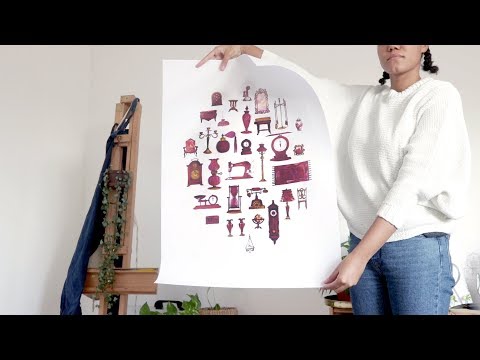
Hello my loves and welcome back. I don't know if this will be the first video
that you see in the art room but it is the first one I'm filming in here so excuse
the mess, excuse the echo! As you know, I like to kind of close off a big drawing
project or challenge with a kind of final piece, a real culmination or
physical representation of the achievement of completing the
challenge. So this Inktober is no different. I actually wanted to do
something a little different. So in the past, I've done zines and I've had it in
my mind for a little while now that I've wanted to do a large poster for
something and I thought this would be a great opportunity to get that done. I
just think you know to bring together all of those 31 pieces of work into one
big cohesive piece to represent the finishing of this challenge. Now
obviously this is going to be a large undertaking and not least because I'm
starting a 31-day challenge on day 13 so I have a lot of catching up to do but I
thought I would take you along with me from you know making the art to
scanning it, editing it and optimising it for high-res, high-quality large
scale printing- I'm actually thinking to go around a1 size so we'll see how
that goes- and then obviously the next step of
actually getting it printed. So this video is sponsored by Intel; working on
this kind of scale with so many high res files in Photoshop, it really benefits
from Intel's optane memory and a good processor, but we'll see how my computer
ties into everything later on in the video. For now we have to make some art!
Now you can watch my 'First Half of Inktober' video up here or over here but
as I said, it's a daily drawing challenge for the whole month of October,
I'm just starting today because I've been dealing with the stress of moving
so I'm doing my own kind of version of the challenge, instead of drawing every
day which obviously isn't doable with my life so up in the air right now, my goal
is to finish the month with 31 finished drawings- ink drawings, and using limited
color palette which is going to be quite a challenge for me, but all-in-all that's
kind of my version of inktober for this year. And you can see in detail how I get
on with that in the video that I mentioned earlier. I'm drawing in
different sizes but with a general idea of how it will come together. I'm going
to digitally stitch each individual drawing together, just rearrange them on
Photoshop and I'm aiming to end up with a piece that will fit all of these
drawings into about an a2 size. As I said, I want to double that for the poster but
scaling up shouldn't be an issue if I make the right decisions when it comes
to scanning.
So that's where we're at now. Back in 'the office' which if you're new here is just
my old bedroom at my mum's house. All my tech stuff is still here at the
moment just because at the new flat we don't have the internet set up yet so
I'm back here to get on with the scanning portion of things. All the
art is done, I've got 31 individual pieces here; some hits and misses but
overall really happy with what I've ended up with. And I would have a similar
process at this stage with scanning even if I had just one large piece because my
scanner only scans at a4 size, I would still have to do multiple scans
and stitch those together. Yeah... with 31 individual pieces I'm gonna put
as many things in the scanner at one time as I possibly can and then just
stitch together as many files as I end up with at the end. It's gonna require
several scans and lots of stitching so wish me luck. A lot of scanning settings
come down to personal preference and also down to the software comes with
your scanner and things like whether you want to apply sharpness and whether you
want to do automatic colour correction or if you want to leave that all for
yourself to do once you're editing but one thing that you really don't want to
leave to chance is your dpi which is the pixel-like dots that make up a
whole image. So for a piece that I'm planning on scaling up, obviously the
more dots the better. The only issue with that is that you can end up with a much
larger and much more complicated file in the end- especially as I prefer to scan
things in TIFF format which means that I'm ending up with a totally
uncompressed file. You're getting all that pure, visual information crammed
into all those millions of billions of dots that you're then free to do
whatever you want with without compromising the quality. So in the end
I've got quite a few of these files that I'm gonna be working with, so the next
thing to do will be to load them all up into Photoshop, edit them, edit the colours
and adjust the sharpness, stuff like that. Just kind of optimise visually, stitch
them all together and then just get the finished piece looking right for that final
print. And that is why I'm really grateful to have a computer like this
one. It can do all that without making an issue of it. I know you guys will be able
to relate -or at least some of you will- working with loads of big files on
Photoshop and just essentially waiting for it to crash... thankfully I don't
really have to worry about that happening anymore.
The combination of working with large raw image files in large applications
needs a really hefty processor and some clever memory usage to allow you to work
seamlessly and just end up with the best quality that you could have.
So here I have the Lenovo IdeaCentre 520 and with it, I have a huge amount of
control over how I use large files, just not waiting for things to load or
struggling to pull files to and from different applications. So I have the
freedom to work with scans that are professional quality to my mind, much
larger than I ever would have thought of working with at home. So for example I'm
opening an a1 size canvas now on Photoshop, just making sure to optimise
the settings for prints, I think I went for 300 dpi, just making sure to switch
to CMYK for the colour profile just so there are no surprises when it comes to
printing and of course just making sure I've set up in the right dimensions,
right orientation. And now I've set up what in the past was quite a hefty and
complicated workspace, but it hasn't slowed down my workflow. Now the thing
about Optane Memory is that it's kind of tailored to my habits so it's
adapted to my regular practice of launching Photoshop straight after running my
scanning software, so it almost seems like Photoshop is ready to load before I've
even launched it. Right so as I said I'm just trying to get the colours as close
to the original as possible, position things in a way that I like them.
And I have to say, editing artwork is so much easier and possibly
actually quite fun when I have a computer that can handle everything that
I'm throwing at it regardless of file size and I can continue to switch and
add scans without the fear of crashing this software or just waiting around
while it is stutters and lags. One other thing I love about having a proper computer now is
the more physical aspect of things; the difference it makes having a large
screen and the lack of glare giving a true and detailed representation of the
finished piece. So obviously when I'm happy I will export the file and
different printers ask for different specs so I just treat each individual
project differently when it comes to which file type and exporting to. And
then when it comes to you finding printers I always approach it from the
point of view of finding someone that does the specific thing I'm looking
for rather than looking for just any old printer, general printers, the nearest to
me or the cheapest. I will set out on a search either online or just locally for
someone that will do what it is that I want for that particular project, be that
a7 size booklets, or in this case a1 posters with a matte
finish which is what I was looking for today. Before I take my files to them or
send them off with whatever information they're asking for, I will make sure to
do a test print myself at home - obviously on a much smaller scale- just
to make sure that everything is laid out properly and the colours are coming through how I
want them to, just to avoid any surprises once the final piece gets you and
then all I can do is wait. And here we are! The surprisingly pain-free project
and what to me it's a pretty impressive final product. I know you guys really
appreciate these in-depth behind the scenes videos so I hope this one hasn't
disappointed. Let me know if there's anything I've missed, if you have any
questions, as always don't forget to check out the description for any useful
links! If you want to find out what Optane Memory can do for you or you
want to learn more about this computer, there'll be links in the description for
you to follow but other than that guys, thank you so much for watching and I'll see you in
the next video! Bye!

Không có nhận xét nào:
Đăng nhận xét