From a treacherous and secluded island to an intricate underground network, today we
look at forbidden places on Earth you should never visit:
9.
Area 51
This is a United States Air Force facility that is also known as Groom Lake and Homey
Airport; it is located in Lincoln County, Nevada.
The name Area 51 was used by the CIA in a document during the Vietnam War.
The area surrounding the field is called Restricted Area 4808 North.
The main purpose of the base isn't publicly known; but, it is most likely used for weapons
systems and aircraft testing.
Since everything that happens at this site is Top Secret/ Sensitive Compartmented Information
that remains a mystery to most civilians, people have developed conspiracy theories
over the years.
The most common speculation is that Area 51 is home to alien research.
Many people believe that government workers at the base examine fallen alien spacecraft
and other UFOs.
They also think that extraterrestrial beings have been discovered and are being kept for
further studies.
Other theories include the development of weather controlling equipment, technology
for time travel and teleportation, and the creation of bizarre aircraft.
There are warning signs around the area that warn people not to trespass or take pictures
and that offenders are susceptible to lethal force.
8.
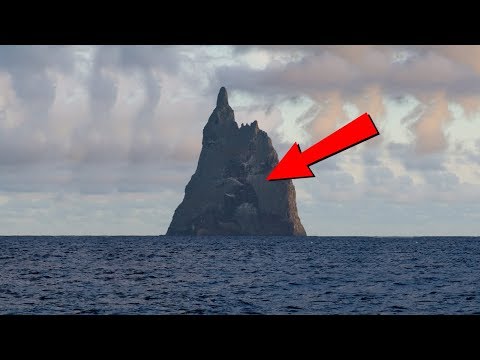
Ball's Pyramid
This unique, natural structure is located in the Pacific Ocean about 12 miles southeast
of Lord Howe Island.
It is the remnants of a shield volcano, and it is 1,844 feet high, 3,600 feet long, and
980 feet across.
Ball's Pyramid is the world's tallest volcanic stack.
Lieutenant Henry Lidgbird Ball reportedly discovered it in 1788.
However, it wasn't until 1965 that somebody climbed to the top of Ball's Pyramid successfully.
In 1982, a law was put in place that prevented people from scaling the jagged formation.
Eight years later, they began allowing some people to ascend the pyramid under precise
conditions.
Ball's Pyramid has the only known population of wild Lord Howe Island stick insects left;
they were presumed to be extinct after a sighting in 1920.
They failed to find a live specimen until 2001 when scientists discovered a population
of 24 insects about 330 feet above the shoreline.
Since then, the stick insects have been bred successfully, and the plan is to reintroduce
more of them to the island.
Besides the rules against climbing Ball's Pyramid, another reason you shouldn't go
there is the steep climb that could end badly for inexperienced people.
Plus, it's best not to disturb the stick bugs.
7.
North Sentinel Island
This treacherous island is in the Bay of Bengal about 22 miles west of Wandoor, a town in
South Andaman Island.
It takes up about 23 square miles in total.
Coral reefs surround North Sentinel Island, and it is covered in forest.
But, don't let the tropical allure of this place fool you into going there.
The people who inhabit the island are a far cry from the civilization that we're accustomed
to.
The Sentinelese have rejected contact with the outside world and use brutality to make
sure nobody goes near their island.
In 1867, a ship crashed near North Sentinel, and the survivors went to the beach where
they had to defend themselves from the natives before they were eventually rescued.
In 1880, an expedition traveled there to research the people and the culture.
They found and captured an old couple and their kids and took them to Port Blair.
Due to their vulnerability to disease, they got sick quickly, and the adults passed away.
The children were given gifts to atone and brought back to North Sentinel.
Peaceful contact was made with the Sentinelese in 1991, but people stopped visiting the island
in 1997.
After an earthquake in 2004, the Indian government sent a helicopter to check out the island;
but, the natives threw stones and shot arrows at it.
Two years after that, a couple of fishermen ventured too close to North Sentinel, and
the islanders executed them.
The Indian government didn't prosecute them for the crime.
There hasn't been any association with them since then, and an exclusion zone that spans
three miles was put in place around North Sentinel Island.
6.
Snake Island
This island is located in the Atlantic Ocean off of the Brazilian coast.
It earned its name due to the significant amount of snakes that live on the island.
Some estimates suggest that there is one snake to every 10 square feet.
But, the snakes on this island aren't like the average garden variety; they are golden
lancehead pit vipers.
They are only found on Snake Island and are severely endangered.
These reptiles got stuck on the island when water levels rose and enveloped the land leading
to the mainland.
Despite this, they adapted to the environment, and their population increased rapidly.
Due to the substantial number of snakes, the island became unfit for visitation.
So, Snake Island isn't open to the public for the good of the snakes and people.
There are an estimated 2,000 to 4,000 vipers on the island.
Although there is no official record of a golden lancehead biting somebody, other members
of the species are to blame for more lethal bites to humans than any other type of snake.
So, even if you could, traveling to Snake Island would be a dangerous expedition.
5.
Global Seed Vault
This place is on Spitsbergen island in Norway.
It is 390 feet inside of a sandstone mountain.
The Nordic Gene Bank has been storing frozen seeds since 1984, and the Seed Vault opened
in 2008.
The goal of this place is to make sure that there is a backup plan if the world experiences
a crisis.
As of February 2017, there were a total of 930,821 seed samples in the vault.
But, it can store up to 4.5 million of them, and each one contains about 500 seeds.
They are stored at -0.4 degrees Fahrenheit with little oxygen to prevent them from aging
too quickly.
The permafrost inside the mountain helps cool things down, and it is 430 feet above sea
level, which keeps the area dry.
Although people aren't able to get the seeds by going into the vault, they can request
samples from the gene-banks that deposit its specimens.
The Global Seed Vault operates similarly to a bank; the donors own the samples, and they
are the only ones with permission to access them.
4.
Heard and McDonald Islands
Also called the Territory of Heard Island and McDonald Islands, or HIMI for short, these
islands are located about 2,480 miles southwest of Australia.
They are a group of desolate, volcanic Antarctic islands.
The total area they encompass is about 144 square miles.
HIMI was discovered in the middle of the 19th century and became an Australian territory
in 1947; they house the last two active volcanoes in the country.
They experience strong winds that average 16.2 to 20.8 miles per hour at Atlas Cove;
however, there are records of winds reaching upwards of 110 miles per hour.
Heard Island is home to numerous telluric environments in which a variety of vegetation
grows.
There are approximately seven known communities for this array of plant-life, and Heard Island
is the most sizable subantarctic island that doesn't have any human-introduced vegetation.
It is known for its diverse animal species, which include penguins, seals, flying birds,
and invertebrates.
There are 15 types of aerial birds and four kinds of penguins.
The island is also home to three species of seals.
Invertebrates make up the majority of the island's inhabitants, although they're
harder to spot.
Due to the diversity of life on these islands, they are protected by strict laws and are
located within a reserve.
However, if you're set on going and willing to brave the wind, you can get authorization
from the Australian Antarctic Division.
3.
Metro-2
This is an alleged underground system in Moscow, Russia.
Construction supposedly began on Metro-2 during Joseph Stalin's rule of the Soviet Union.
Although Metro-2's existence isn't verified, it hasn't been denied by the Federal Security
Service, or FSB, or the Moscow Metro, leading people to believe that it could be there.
The United States Department of Defense put out a report, titled Military Forces in Transition,
in 1991 that discussed an underground government facility in Moscow, which encompassed a map
of the supposed railway.
There are four presumed lines of Metro-2 which connect to the Kremlin complex, FSB headquarters,
the airport, and the underground Ramenki bunker.
The D6 Line is the only one that has been photographed and whose existence is verified.
The Vnukovo (vuh-nu-kovo) airport line was apparently built for emergency evacuation
for government officials; the airport was originally used exclusively for military reasons.
A third line, Izmaylovo (iz-my-lovo), was supposedly constructed for Russia's Strategic
Rocket Forces.
Through deductive reasoning, we can assume the last line would connect to the "Underground
City" in Ramenki, which is the most significant underground bunker in Moscow; it is also referred
to as Ramenki-43.
If the theories are true, then this subterranean system holds many historical secrets.
2.
Monkey Island
Also known as Cayo Santiago, this island is located about a half mile east of Humacao,
Puerto Rico.
In 1938, 409 Rhesus monkeys were taken from India and placed on the island.
Nowadays, there are over 1,000 monkeys living there.
No humans live on Monkey Island; however, it is the University of Puerto Rico's research
center, and people who observe the primates travel to Cayo Santiago every day to continue
their studies.
Although there is no real law in place preventing people from traveling to Monkey Island, it
is highly recommended that they don't.
One reason is that the monkeys carry the Herpes B virus, which can be lethal to humans.
So, when people do visit the island, they are told not to let the monkeys urinate on
them.
Another reason not to visit Cayo Santiago is that people can transfer diseases to the
primates, which would spread very quickly among their dense population.
You can, however, book a kayaking tour that goes near the island to safely view the monkeys
from a distance of 30 feet.
1.
Varosha
This city is located in the district of Famagusta in Northern Cyprus.
It was the finest tourist destination in the country in the early 1970s.
Varosha was inhabited by nearly 40,000 people before the Turkish invasion in 1974.
They closed the area off, and the only people allowed into Varosha were United Nations workers
and the Turkish military.
In 1984, the UN Security Council Resolution 550 demanded that the city be given to the
UN administration and stated that it could only be resettled by the people who had to
leave.
However, Turkey didn't comply and kept hold of Varosha to try and convince Cyprus to agree
to a settlement plan.
So, it became a ghost town.
Nature has overgrown the buildings; it looks like a post-apocalyptic world where stores
are still stocked with clothes, tables are set, and cars from the 70s are parked in garages.
This place is off limits to the public, and there are warning signs everywhere.
Photography isn't allowed either, and they are willing to use lethal force on those who
trespass.
 For more infomation >> Wait, Could You Actually Ditch Heavy Weights At The Gym With The Power Plate? - Duration: 1:27.
  For more infomation >> You'll Cry When You Hear This Heartwarming Pet Story - Duration: 3:06.


 For more infomation >> 滄海桑田,已經全球化的美國資本,無法挽救 - Duration: 17:49.

 For more infomation >> Kali dual boot error: NMI WATCHDOG, soft lockup on cpu - Duration: 2:10.

 For more infomation >> Brett Kavanaugh Hearings: Megyn Kelly Discusses The 'High Stakes' | Megyn Kelly TODAY - Duration: 10:34.


Không có nhận xét nào:
Đăng nhận xét