Guys, behold the ant keeping piece de resistance.
What you are looking at here is the dream setup and species of nearly every pro ant
hobbyist in the world!
Trust me!
We absolutely drool over this ant farm setup!
So this week, I wanted to take a short break from our regularly scheduled ant soap opera
of our cherished ants in the Philippines, and take a trip all the way to Montreal, Canada
so we could completely nerd out at one of the most impressive captive ant setups I have
ever seen.
What you're about to see in this week's video is the dream ant setup nearly every single
ant nerd on the planet, like myself, has dreamed of having, and I can't wait to explain why
in perfect ant nerd fashion, as we tour the Espace Pour La Vie Montreal Insectarium's
leaf-cutter ant exhibit, and talk about what makes these fungus-farming ants some of the
most biotechnologically advanced organisms on the planet.
You won't want to miss all the epic ant discovery ahead, so keep on watching until the end!
AC Family, gather round to ant watch and completely geek out wit me!
On this episode of the AntsCanada Ant Channel.
Please SUBSCRIBE to my channel, and hit the bell icon.
Welcome to the AC Family.
Tired on nature channels not playing nature shows?
Just watch this channel.
Enjoy!
I'm currently back in Canada for a work trip, and my travels took me to the gorgeous French
Canadian city of Montreal, which happens to house one of my favourite spots in the entire
country: the Insectarium.
Entering the building you find a tonne of insect exibits, but of course my favourite
was this.
AC Family, welcome to the Atta exhibit, an impressive 7 yr old colony of leaf-cutter
ants.
Now if you're new to leafcutter ants, let me tell you, these ants are some of the most
mind-blowing ants ever!
Last year, we covered them in an episode featuring a desert species of leafcutter ants, which
I highly recommend you watch after this video, but these girls are a tropical species of
leafcutters from South America.
These ants belonging to the genus Atta, are called leafcutter ants because of how they
cut up pieces of leaves and use them to feed their underground fungus gardens which they
eat.
That's right, these ants farm microscopic mushrooms for a living.
Now check out how brilliant this setup is!
Let's take a tour, shall we!
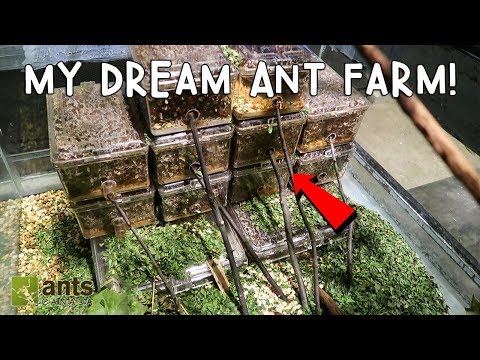
Here is the main nesting basin.
Inside it are clear acrylic containers which simulate underground chambers for the ants,
and inside each one of those containers are the gorgeous fungal gardens.
Yes, those greyish honeycomb-looking things are the ants' giant fungus balls which they
tend and care for very meticulously.
You see, these ants must ensure that these fungus crops remain healthy and continue to
thrive because without them, the entire ant colony would die, but more about that mind-blowing
activity later.
So each acrylic container has an opening to which a stick is fixated in order for the
leafcutter ants to climb so they can drag their cut up pieces of leaves into the chambers.
Inside each of these chambers is a plaster floor which helps keep the inside nice and
humid, necessary for the ants and the fungal gardens to survive.
In the wild, these ants create deep chambers to house their massive fungal balls, but they
will also be opportunistic as seen in this setup and occupy any readily available space
with ideal conditions.
I was once in Mexico and watched an Atta colony bringing leaves deep into a sewer.
Seems these ants are resourceful and willing to use whatever's available in order to survive.
Now let's move backwards and see where the ants are getting all these pieces of leaves,
the food for their fungus.
Traveling up this trunk base, and up this wooden branch, and down this neat entanglement
of banches, we come to the source of their fungus food.
At the other end of their setup, the ants reach an assortment of various leaves and
hibiscus flowers.
Leafcutter ants don't accept all kinds of folliage, but amazingly the ants seem to know
which plant matter would best nourish their fungus, aka their food, and it's those that
the ants cut up and bring home.
Isn't that just amazing, AC Family?
It seems the ants and their fungus have a mutual understanding.
Perhaps psychically bonded?
Well, let's leave that for another video!
The leaves and flowers are kept fresh by way of waterpicks hidden strategically around
the branch entanglement.
Also available to the ants are rolled oats, which the ants also seem to love, or should
I say their fungus seem to love.
Now you may notice that this setup is glassless, so you may be asking what is keeping the ants
from escaping into the museum.
Well, a thick band of this stuff called fluon painted across all vertical surfaces of the
basins are super slippery for the ants and it keeps them from climbing out of the setup.
Each basin is also surrounded by a moat of water for extra security.
Any ants traveling across the braches that might slip and fall also fall into a basin
secured with fluon and surrounded by a moat.
Now this leaf-cutter ant colony is 7 yrs old and contains 1 egg-laying queen living somewhere
in one of these acrylic containers.
She is large and apparently is seen sometimes emerging to switch containers but is always
surrounded by a massive ball of workers protecting her.
I love watching the ants traveling back and forth carrying their pieces of cut up leaves,
flowers, and oats back to the nest.
It is just so entrancing and fascinating watching the ants work tirelessly.
I could literally be here for hours.
How about you guys?
Let's watch them for a bit.
Speaking of ant watching, one of the coolest parts of this ant setup is the fixation of
a webcam right here, which projects the ants working onto a screen so you could watch the
ants around the clock.
Not sure if at one point this was streamed online, but it gave me an idea.
AC Family, if I managed to hook up a 24 hr stream of my ants back in Manila, would you
tune in to watch?
Which colony would you like to see a stream of?
Let me know in the comments section and perhaps we just might make it happen.
Now I feel the reason ant keeping as a hobby is so appealing is because of how much ants
are like humans, and in my books, these leafcutter ants are some of the most human-like ants
around.
They're farmers for goodness sakes and not only that, they've been farming for millions
and millions of years on this planet, way before humans ever appeared on earth.
There are even fossils of leafcutter ants as far back as 20 Million years ago.
And speaking of human-like, check out their massive pile of garbage, yes that orange hill
is the colony's garbage.
Alright so here is the portion of the video where we're about to completely geek out,
yes, more than we already have.
So are you ready to hear what makes these ants so incredible in the biological world?
Prepare to be mind blown, AC Family!
Ok, get this.
These ants grow their fungus which they eat, right?
But believe it or not, like humans, the ants have to deal with weeds, bad fungus which
feed on their good fungus.
So, the ants have a built-in weeding system.
Check it out!
Special patches on their body house colonies of a specialized bacteria called Actinomyces
and these specialized bacteria produce an antibiotic which kill the fungus weeds.
See this photo of a leafcutter ant which looks like it is covered in white hair?
Well, these white hairs are the strands of antibiotic which help kill the weed fungus
which kill their food fungus.
But that's not all.
The mind blowing part is that the leafcutter ants, their food fungus, the weed fungus,
and the specialized bactera are all only found within these leafcutter ant nests, nowhere
else in the world!
Isn't that just crazy?
These four organisms are so interdependent on each other that they cannot exist without
eachother, and do so only in these leafcutter ant nests.
Scientists are even trying to study the antibiotics the actinomyces produce in hopes to produce
antibiotic alternatives for humans.
Aside from that, these ants are important herbivores in the ecosystems where they are
from, so conservation of their habitat is super important, which brings me to why I
don't own a colony of these leafcutter ants and a dream setup like this.
I live in the Philippines, where leafcutter ants like these don't exist, and if you've
been following this channel for awhile you might recall a previous video where we outline
the dangers of keeping ants that are not from your area.
We have always promoted the notion of responsible ant keeping among private ant keepers and
hobbysists, meaning the keeping of ants caught from one's area, but we do have one exception
to the rule, and that is in cases like this where the imported creatures are housed under
very controlled environments for the purpose of public education and/or study.
Meet Dominic, the resident Myrmecologist of the Insectarium and the one who has cared
for this colony since they first received it 7 yrs ago.
He just so happened to be refilling one of the food stations with oats when he spotted
me filming and told me he was also an AC Family member.
How neat!
Dominic said the Candian govement granted them a very special permit for them to display
these animals and have them in the museum, and also mentioned that they are under constant
serveillance having to abide by super strict terms regarding maintaining the exhibit and
keeping it secure so to not allow the ants to escape.
Even if these tropical ants may theoretically fail to survive a Canadian winter, there are
still other ways in which escaped ants can negatively impact the environment here in
Canada including spreading disease or other pathogens to local flora and fauna.
Also, there are other variables that one might consider including the survival of the ants
in indoor enivornments during the winter.
However, it's totally awesome that one can visit amazing places like the Montreal Insectarium
here to get up close and personal and get a glimpse at the lives of these amazing leafcutter
ants, which in turn will go on to inspire others to admire their beauty, perhaps inspire
them to seek further research about them.
It is also one of the reasons why this channel exists, the more people know about how awesome
ants are the more people respect them and want to conserve them and their habitat, and
that is definitely a good thing even for our own good.
Thank you guys for contributing to this growing ant consciousness by watching this video.
I truly appreciate it!
Don't forget, guys to give this video a thumbs up, hit the Like button, and subscribe if
you enjoyed this video, and hey, even though I can't have this setup at home, it doesn't
mean I can't do something similar with ants from where I live.
What do you guys say we try to create a similar setup at home in the ant room?
Which ant colony though would do best in a setup like this?
Perhaps a whole new ant species like Asian Weaver Ants?
Oh boy!
This may be a very big undertaking!
I'll also marinade on some ideas and take in some of your feedback.
AC Family, until next week, this is your ant nerd AntsCanada signing out.
It's ant love forever!
Alright, AC Family!
Aren't leafcutter ants pretty cool?
I'd say so!
AC Inner Colony, I have left a hidden cookie for you here if you would just like to watch
some extended play footage of these ants doing their thing in this impressive exhibit.
I have also left a link in the description box to the Insectarium's website if you would
like more information on the exhibit or on what other cool things you can find in the
Montreal Insectarium.
And now it's time for the AC Question of the Week.
Last week we asked:
Name one reason why we felt the terrarium in the video was haunted?
Congratulations to Kylo Ren who correctly answered:
Everytime we tried to move an ant colony into the
terrarium they either died or caused a problem.
Congratulations Kylo Ren you just won a free ebook handbook from our shop!
In this week's AC Question of the Week, we ask:
How do live ant exhibits like this help ants, humans, and the environment?
Leave your answer in the comments section and you could win a free ant t-shirt from
our shop!
Hope you can subscribe to the channel as we upload every Saturday at 8AM EST.
Please remember to LIKE, COMMENT, SHARE, & SUBSCRIBE if you enjoyed this video to help us keep
making more.
It's ant love forever!

 For more infomation >> ... Thank You! - Duration: 1:51.


Không có nhận xét nào:
Đăng nhận xét