Hi everyone welcome to today's webinar entitled
When You Can't Ask The Resident: Practice Guidelines For Asking Proxies
About Resident Preferences. My name is Kendall Leser and I am the
project manager for Ohio's PELI-Can program aimed at promoting
preferenced based person-centered care in Ohio's nursing homes.
Before we get started with the presentation I have a few housekeeping items to
go over with you. I ask that for those of you seeking Ohio
Social Work CEUs, which I believe can be transferred to Nursing CEUs
to please take a moment and click under the chat box
and complete the form. In order to issue CEU
credits we must have a record of you signing into and out of the webinar.
At the very end of the webinar you will be asked to complete a
webinar evaluation and enter the time that you exited the webinar.
Please expect to receive a PDF of your CEU certificate
via email within the next two weeks but most likely
more quickly than that. It is very important
that we have documentation of every single person who is requesting CEUs
so if multiple people are viewing this webinar on one computer
each individual person need to take a moment and sign in and sign out
of the webinar as well as complete an evaluation form at
the very end. Again, the link to sign in
to the webinar is under the tap box and you can just click on that link right now.
During today's webinar we will
be discussing special considerations for proxy
interviewing tips for incorporating friend and family insight
into assessments and care planning and identifying ways to build staff
observation skills when a proxy is not available.
If you have questions throughout the webinar, people type them in the
Q&A chat box and we will answer your questions at the very
end of the presentation.
And you'll see on the screen right now
where the arrow is, that's where you can type your questions and the panelists
will be able to respond to those at the very end. Now I
would like to introduce our speakers for today's webinar. Dr. Kimberly Van Haitsma
is an Associate Professor of Nursing at Penn State University as well as
the Director of The Program for Person-Centered Living Systems of
Care and a Senior Research Scientist at the Polisher Research
Institution at Abramson Center for Jewish Life.
Dr. Van Haistsma's research focuses on seeking to understand
the impact of contextual issues such as the physical environment, culture of
care, staff interactions, interdisciplinary team processes,
and psychotherapeutic approaches to quality of life and quality
of care deliver for frail seniors receiving services in the long
term care setting. Our next presenter is Dr. Katy Abbott.
Dr. Abbott is the Robert H. and Nancy J. Blayney Assistant
Professor of Gerontology and a Scripps Gerontology Center Research
Fellow at Miami University. Dr. Abbott's research and teaching
focuses on preferenced based person-center care with a special emphasis
on person's with dementia. Dr. Van Haitsma and Abbott have
co-authored over a dozen peer reviewed articles related to the PELI. I will
now turn it over to Dr. Van Haitsma.
Hello everyone and we welcome you
to this webinar. We do want to just
let you know that the advice that we're providing today
really comes out of our history in working for
over 15 years with long term care organizations.
Older adults, family members who were
seeking to implement the PELI in
within their organization and so the advice that we're
going to provide here today is really to
help the thinking around developing an action plan
as to how to use these preferences and
in your daily care activities the development of procedures and
policies and formalize a
standard for how these preferences can assessed and as
we've already mentioned today, the goal is really focusing on when the resident
cannot be interviewed and when we have to go to other sources
for getting that information.
Finally, our goal as whole for this project is to really look at
how you can utilize that information to leverage better
care in the daily care that you provide.
So lets talk just a little bit about
person-centered care benefits and some of this is kind of
preaching to the choir because if you guys are on this call you are already
understand that the person-centered care benefits
residents, staff and family members but just to
give a brief overview, the literature is pretty clear
in the findings that provision
of person-centered care fosters engagement on the part of the resident
and improves their quality of life and well being.
Primarily because preferences are the avenue toward understanding what is
meaningful and purposeful to us all. We prefer those things that are
that have specific meaning to us and that is certainly
true for a nursing home resident. It also
helps to facility the resident feeling of autonomy
and their ability to have their voice inserted into
directing the care and services that are being provided
certainly goes a long way to creating a care environment of trust
and respect and building those closer relationships with
the staff that are providing the care. Next slide please.
From the staff perspective
again the literature is pretty clear that person-centered care has a host
of benefits. Staff members are definitely
reporting being more comfortable caring for people that they know
that they have a better, stronger partnerships with the residents
and their families when preferences are discussed and
of course the staff who the persons preferences can adapt
more quickly to that persons ever-changing needs and
requirements for their care and how they like to live their daily lives.
Finally, staff who
provide person-centered care are highly valued
within their organizations than the information that they
have in terms of knowing more about the residents preferences
and needs help them to work more efficiently and devote their time
where it's needed most. Where
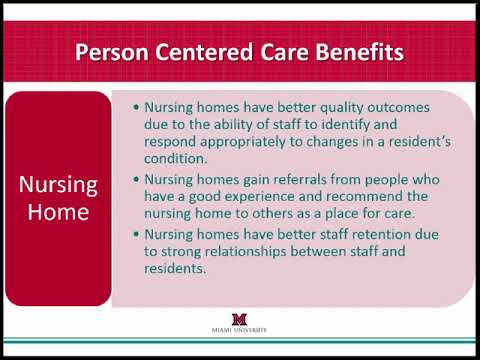
the organization itself, nursing homes who deliver person-centered
care are shown to have better quality outcomes
and aging this is largely due to the ability of staff
to more quickly identify and respond to the changes
of a residents condition but also
nursing homes can gain referrals from people who have a good expereince
and recommend the nursing home to others as a
place to receive good person-centered care and then also some evidence
to suggest that nursing homes have better staff retention
again due to that building of that relationship between staff
and resident. So typically
when you would seek to assess preferences of
course we would ask the resident first and that interview
process and talking with the residents is to find out
which preferences are the most important important to him or her, how
satisfied they may be with wether those preferences are being fulfilled
at moment in time but
of course what happens when the resident is unable to communicate
and cannot be interviewed? So just like we would do with
anything related to the MDS or any other assessment tool
we would seek out a family member or friend who knows that resident
well to begin the assessment process
So what does the literature tell us in terms of what we know about
family members or friends as proxies
and speaking for the residents and their loved ones?
Well, we know that of course families continue to provide
support to older adults even after they enter the nursing home so they're
very much there and want to be apart of the
partnership of providing care and in fact
families serve a very important role in helping to support
individualized care in the nursing home environment.
On the flip side though, we also know that family members
are not always fully understanding what
an older adults preferences may be and this can be a variety of reasons
why that is true. Some folks may not have
actually provided care to the older adult
or they may live at a distance and not fully understand
where the person is coming from and
their daily activities and daily needs at the moment but
having said that, the literature is pretty clear
that proxy reporters are right
more often than wrong in terms of their
reporting of the preferences of their loved ones
and so on balance we know that it is a good idea
to go and ask family members about
the preferences of their loved ones.
So just to say a little about some of the work that we've done, we recently completed
this study where we were looking 20 different nursing homes and
resident and family member a dyad
that participated in this study.
And the nursing home
residents were cleared by a physician
for capacity to consent and that they were medically stable so
again to be clear we were talking with nursing home residents who could report
on their own preferences.
This was using the tool for the
PELI itself which is, as you all know now, a 72
item tool that helps
us to assess the importance of everyday preferences in care.
The
findings from that study were that you can see here
reading through what some of the agreement was between those
residents who could speak for themselves and their
family member or friend and these were some of the areas
where there were very good agreement in terms of what the resident
said they preferred and what the family member reported
that the resident preferred. So some nice
checks in terms of that if we ask a family member
about eating, how the resident feels
better when they are upset, what clothes they want to wear, privacy
things like that, these are all things that we can reliably
take from a proxy and say that
we can care plan around these types of preferences.
On the other hand we
look at some of the deviations about where preferences
reported by both the proxy and a nursing home
resident may be different. So here proxies underestimated
the importance of the residents
level of importance in listening to music, being involved in cooking,
exercise, volunteering your time, being around children,
choosing your own medical care professional and how to care for
your mouth. So these are things that where the proxy thought that
the things were not as important to the resident and the resident said no
these are things that are on average very important to me.
On the other hand, there are three preferences
where proxies overestimated the importance of the preference compared
to the resident. So the proxies thought that having
snacks available between meals was more important than the resident did
napping was more important and choosing what time to get up.
So again, these are just some guidelines for you to think about
as you use your clinical judgement and
taking the responses from proxies and moving
forward from a care planning perspective.
So in conclusion families are
getting it rigth on the majority of preferences
and so really are an important source about the residence preferences
when they can no longer be interviewed.
Great, Thank you Kimberly.
So this is Katy and I'm going to take over from here and walk you through
our tip sheet on working with proxies.
You'll find this download as part
of the webinar, if you have troubles we have our e-mails
at the end of the webinar and you can e-mail us directly and we can send you these
PDFs. So the first piece that we wanted to go over
with you in terms of working with proxies is
this idea of approaching
the resident three separate times on different days
before determining that the interview cannot be
completed. We realize that residents
have good days and bad days and we want to
try and approach them different days and times of day to make
sure that we really are not able to get information
from them. Then decide if you're going to
perform in-person interviews with your proxies, if your going to
do phone interviews with your proxies
if you want to do an e-mail survey monkey
send it by snail mail or a combination.
So there are some things that your orginization will need to think about.
Think about which staff member among your organization
will perform the proxy interviews and coordinate with the family or
friend proxy. There's been a lot of
talk about which family member or friend should be asked to participte
in the proxy interview and this is a process by which you might ask
who among these variety of family members
might be the best one to
do the interview. Finally,
create an information flyer to include in new admission
folders explaining the reasons why perference assessments
are being performed with your organization.
Additional tips in engaging with family and friends,
is to help the family and friend understand why
is it important for providers to know about resident preferences.
It's a little bit of educaiton right here where you have
to explian to your family members
and to their friends that knowing about this resident
will help you provide more tailored care
and it's information to help improve both the medical and
non medical aspects of care because there's more than just
medical parts of care. It's important to recognize and
reiterate that the family or friend voice does not become a
replacement of the residents vocie, but that it's a compliment
in the care planning process.
We recommend engaging family and friends by
using them as an additional resource
for finding further details about residents preferences.
They can help discover interests
that can be used to create unique and individual tailored interventions.
Finally, the family and friends may be interested in
serving as a care parter and facilitating activities related to a residents
important preferences. We've heard from some organizations that residents
will refuse to go to activities and they recommended that family members
try to come and go with them to activities
and that may help facilitate
the activity and the resident feeling more comfortable doing
those activities. It's
also important to support family and friends in
recognizing that dispite physical and functional declines
preferences do remain important to the
older person and if the person is not able to do them well
or as well or is not as
involved in the care, it's at these times
we see that family support with preferences
is even more critical. When there's greater decline that even
a small pleasure can be
experienced and with the
support from the staff and the activites staff
can modify these important preference to a persons current
abilities is crucial.
So if you choose to do in-person interviews
we recommend that you find an interview location
that quite and private, we
recommend that you try to work the proxy to find
a time that is convenient for both of you, and be sure that the proxy
can hear you to the best of their ability. If
the proxy wears glasses or earring aids try to remind them and ensure that they are in place
prior to the start of the interview. These are similar
tips we gave during our last webinar.
And again, review all the interview instructions prior
to speaking with the proxy. You want to be fully prepared
to decrease confusion with the family member or the friend.
Stress how you are seeking what the proxy thinks the resident would prefer
not what the proxy prefers and this is tricky for
it's very difficult for
some people to put themselves in their loved ones
shoes. They might want their loved one to particiapte in all these
activities and it's something
that you just have to constantly stress, "Well what do you think
your mom or dad would prefer?"
If you're going to do phone interviews, we recommend that you
schedule at a time of convenience for this family or friend,
double check when you make the call "is this still a good time to
chat for about 20 minutes?" Explain the reasons why
you're seeking information about the persons preferences so a sample script that we've
provided here for you, "Dear Mrs. Smith, my name is Joe
and I am calling from the Red Hills Nursing Center. Everything is fine with your
mother. We are starting a new initiative to learn more about resident preferences and I was wondering
if you had a few minutes to talk with me about your mother's likes and dislikes. I
have a few questions that we would like you to answer.
We would like for you to take the perspective of your mother and answer how you think
she would if she was able. This information will help us provide better care to your mother."
So again, feel free to take that script and adapt it
for your use. We have
not had a lot of success with mailing
the PELI to family members and proxies and
having it returned to us so
we recommend with option with caution
I think that you will probably have better success if your try to do a
in-person or telephone interview
with individuals. If you do choose to do a postal mail
interview, try to use a larger font size, maybe a 14 or 16
font size in creating the questionnaires just so it's easier to read.
You'll want to include a brief cover letter explaing the importance of
the family and friends in competing and returning it and you might want to include
the date by which you'd like it returned. Sometimes we all work better
with deadlines, right? Include a self address stamp envolpe
for the family or friend to return with postage
paid so they don't have to go to the post office and cover the postage.
We recommend calling with a reminder about 2
weeks after mailing if you've not received it yet to say "please
you should of received this, please complete it and
return it" That might be a time also that if they've not received it
to send another copy in the mail and we recommend
maybe after a month sending another copy with a new cover letter if
need be.
At this point I want to turn it back over to Kimberly
to talk about how
you can also engage staff members as proxies
if you're unable to find a family member or friend.
Go ahead Kimberly. Thanks Katy. So as
Katy mentioned there are many instances where
a person does not have a family member or friend to contact
or they're just simply not responsive
or live too far away or the
family member is not responsive
to the request for information and or
says "I really can't answer these questions".
So in those instances where the resident is both
unable to speak for themselves and
or unable to get a family member or friend we
have to rely on our staff observations
and experiences that with their
direct work with the resident. So
one avenue for
doing this is to observe the emotional response
of the resident in an activity
that you have some reason to think that this is
a preferred activity for the resident and often times staff
has a pretty good sense, most of the time, of what
the resident does or does not prefer in a global sense
and by observing the persons
emotional response to an activity, you can
get a better handle on wether that person is indeed
enjoying that activity and signs of
enjoyment and interest are signs that
an activity is indeed a preferred activity.
Here are two examples of interest and pleasure and the
words that are listed on the screen there are
the discriptions of what
emotion looks like in terms of
its non-verbal expression. So,
things like participating in a task or having good
eye contact or eyes that follow an
object or a person, looking around the room or
being responsive by turning your body toward something, those are all
indications of a person is interested
in what is going on around them and therefore
again, you're hitting the right note in terms of
finding a preferred activity for that person. The
same is true for pleasure so, if a person laughs or sings
smiles, maybe makes kissing motions or
strokes gently touching reaching out warmly,
or responding again to an
activity such as music and this may again be signs that the person
is experiencing pleasure. Now, the beauty of non-verbal
observation of emotion is that
observed emotion has been demonstrated throught the work of
Paul Ekman to be culture free
and true across age groups and different types
of ethnicities. It is truly universal
to how our brains are wired as human beings
to express the emtion non-verbally using these
types of non-verbal indicators. We had done some work
a few years ago to test this out in the context of dementia
and we found that even well into
the course of dementia people retain the ability to
express emotion through these non-verbal means.
So, it's something you can take to the bank in terms of a
way in training your staff for looks for signs of interest
and pleasure and that if you're seeing these then
you can communicate that to the care planning team
that these activities are indeed preferred activities
for that resident. On the other hand if you
see signs of negitive emotions such as sadness
anger, and anxiety then you're in the
territory that is not likely to be a preferred activity
for the resident. Sadness the signs of
sadness are such things as obviously crying but frowning
moaning, sighing, putting your head in
your hand, those are all things that would be an indication
that the person may be experiencing sadness at that time
and during that activity. Anxiety on the other hand
can be evidence by calling out
shrieking or being repetitive in what your
saying, expressions of
restlessness or agitation, having deep lines across
the forehead with the eyebrows
drawn together, hand wringing
tremoring, jiggling, rapid breathing
eyes opened up wide and in general having
tight facial muscles, these are all things that again, we has human beings
express non-verbally when we are anxious.
And then finally, anger is probably the one that's most
easier to rate, it's hard to miss when someone is angry
especially if there's physical aggression going on or cursing
berating, shaking of fist, but there are certianly more suttle
signs such as drawing your eyebrows together, clentching your
teeth, pursing your lips, narrowing your eyes
or waving someone away or with a distancing
gesture. So the
observation of both positive and negative affect
the tool I'll show you next here is
putting together all of those non-verbal signs in
one place about how human beings
express a different emotional state and
there are some training materials for training your staff
we have a couple of videos that are avaliable
that can help you train your staff to be more sensitive
to these signs of positive and negative
emotion and then again, using those as ways
of indicating wether and activity is preferred and if it is preferred
then by all means keep doing it and the negative emotion
is a sign that the activity that
is going on is not preferred and therefore can be
something that can discussed at care planning
to figure out how you can turn that negative affect into a
positive affect for that individual.
Great, thank you Kimberly.
And so, what we'd like to turn to next
is to tell you a little bit about thoughts on care planning.
Please remember to put any questions
into the Q & A that you can see in the lower left
hand corner of your screen. We would
encourage you to encourage the proxy to attend care planning
sessions, either by phone or in-person and
track reasons way they aren't able to
attend and potentially engage in a plan-do-study-act
cycle, quality improvment cycle, to try
to figure out reasons for this non-attendance and make it easier
for these individuals to attend. Their insight could be
very valuable to moving your efforts
forward in terms of person-centered care.
It would be a good idea to have a staff member set up
a meeting with the proxy and the resident prior to care planning
to discuss the results of different tools that
you may use in case you're using the PELI there's also the Advancing Excellence
Person-Centered Care Tool, and develop suggestions for
improving or you might have some ideas you might say
"we found this preference is important to you, what are some ways
that we might be able to fulfill that preference
and how might it need to be modified
and still be fulfilled?" and so again, these
proxies can be engaged on multiple levels
as information
givers and bring assistance
to your care planning.
Our take home message really
with all of the work that you've been doing is that individuals
with mild to moderate dementia can still report
on their values and preference, they can do so reliably and
consistantly. We don't recommend hard cut offs such as
certain MMSE score or a certain BIM score because those
cut offs may not always be the best indicator of a persons capability
of responding about their preferences. So it's really where
as Kimberly mentioned that you come back to your clinical judgement
and research supports the positive impact of having
family and friends involved in care and the fact that they can
provide social supports for a resdient even after transition to a nursing home
and care serve as advocates for individualized care planning.
Often times, family and friends aren't really sure
what their role is
when their loved one is in a nursing home and you can provide some of that guidance
through these structured ways and really try
to welcome them in and say "here are some ways that we can use your
help" if they are willing and if they support
Obviously, we recognize that not all residents will
have this kind of family support.
So, we'd encourage you also to
in the Q & A, indicate any
facilitators or barriers you've experienced with engaging proxies
I think that that's an interesting piece the
more we hear from you, the more we can help remediate some of these
barriers. And then share some of the success as well.
We also want to remind you to
submit your questions to us any time. Even if it's after this webinar
send us e-mails or call us
Kendall Leser is our project manager
and she will take your calls, you can remain anonymous if you wish or you can send
us an e-mail. As we've mentioned during the last
webinar, we really want to create an opportunity for a
partnership so that providers can interact and learn from
eachother by sharing successes and stumbles and we want to
facilitate that ability. As we mentioned
last time we're embarking on a listening tour and would be honored to visit your facility
and learn more about maybe how you intergrate proxy
information into your care plan or engage with proxies or anything
related to the Preferences for Everyday Living
We'd love to hear about, as I mentioned, the barries and the
facilitators and there's Kendall's information again.
To find more resources you can go to the website
www.preferencebasedliving.com It's under construction but there are
some resources there right now. We hope to develop it more fully
over the coming months. Also, please sign up for our newsletter
and I'll paste the newsletter link into
the chat box so that you can
sign up for that, I just put that in there
And then,
also, we want to let you know
that our next webinar will be in January
So, we recognize that November and Decemeber are very very busy months
lots of holidays, lots of activities going
on and so in January we will come back to you
with our next webinar on Promoting Resident Choice
and so this webinar will help identify ways to support
and encourage nursing hoe residents to state their preferences and direct their
care as much as possible.
The information that we'll provide reflects best practices among nursing home
staff and administrators to overcome those logistical
and cultural challenges to respect individual preferences for daily schedules,
activities and interactions. That will be Tuesday January 24th from 2-3pm
Again, there's the link for
participating in the webinar and I'll post it into
the chat box. And finally, we'll stop
here, our e-mails are listed. We want to thank you for attending and we'll go
into our Q&A period now. I see we've got
several questions added to the piece and remember
to stay if you're seeking the CEU
credits please stay on until the end so that you can
sign out of the webinar and we can process your CEU credits.
Kendall, how about questions? Alright yeah
we had a few come in and one of the first questions
is "How important is it for short term residents to have a detailed
PELI and a detailed care plan?"
Well that's a great question, in our last webinar we spoke
a little bit about this where we reccommend
enganging with your long term residents
around the PELI. We recognize that you
may only have short term residents for a matter of days
maybe up to 20 days at most, and they may not see this as relevant
to them and it may be very difficult for you to be able
to even put this kind of information into a detailed care plan
We reccommend starting with your
long term residents on the PELI initiative
and I know that on the last webinar we had Cheryl from the Ohio Department of Medicaid
she stated that one of her most
important is that pain management
is, which is a clinical indicator, not part of the PELI
should be the emphasis for those short term residents
so that they're able to go to rehab and able to get stronger
and better to go home. And one other thing that we've mentioned and then I'll
turn it over to Kimberly for any additional pieces of advice is that
if your organization has a home health organization
doing the PELI with your short term residents might
be a great hand-off to your home care organization to help them
guide care, goals, vaules, and activities.
Kimberly, you'd like to share or add?
Ya, I think that last point is really important to emphasis in that
preferences are something that are
inherent to who people are
as such as something is really important to think about as people
transition across different settings of care. So,
this idea that you would, of course everybody collects
the MDS Section F in short term
rehab so those items of course would be
important to figure into their plans of care
if the person has important preferences
and they will of course leave the short term rehab
with those short term preferences in tact
so starting with the MDS Section F
thinking about how those preferences might
be impacted by the persons particular
reason for why they're in short term rehab, how that may effect them
, their behavior and their goals following a discharge from
the short term rehad, those are all really important
pieces of information that preferences can provide
so unlike in the long term care arena where you're really thinking about preferences
for the perspective of providing meaningful, purposeful
tailored daily plans of care
for the person who is living in their home and short term rehab people
are not living in their home, you're thinking about preparing them for returning
to either their home or their next setting of care.
So preferences serve a little bit different purpose
within short term rehab and I think the short answer starting
with those MDS Section F preference and making
sure that the team thinks about them relative to
that persons next setting of care would be an important
way to utilize the preference information.
Alright, thanks Kimberly. I have
another question that came in and this questions is "Do we need to
use the same response options with proxies as we do with residents?"
Another great question, Kimberly do you want to take that one?
Yeah, so the simplest answer
is to use the same
likert scale as we do with resdients but this has come up
in a couple of different context and sometimes
even though the MDS Section F preferences are laid out
in the exact same response that is the PELI we
actually modeled the PELI after that MDS Section
to make it consistant because we knew that
facilities were already asking, using that response
but in fact what we found is that it is pretty hard
sometimes for people to use that response scale
sometimes you can get the information that you're looking
for which "Is a preference important to that person, yes or no?"
"or mostly yes or mostly no"
is really the goal that
we're striving toward. So unlike the DS where we must use
that response scale, within the PELI there are
some options in terms of using the
'very important', 'somewhat important',
as a yes response and
'not very important' or 'not important at all' as sort of a monstly
no response and kind of moving forward from there
So, I think that if you encounter that same type
of difficulty using family members using that
kind of stratagy for getting at the mostly yes or mostly no
and circling the
response accordingly is referred to as a
unfolding process. That is definitly
another stragagy that people have used to
get the information that they need.
Great! And another
question just popped up, What time frame should the PELI
be completed in upon admission and how
often should they be updated? And so,
We believe that
most organizations have 21 days to complete their
care planning and so,
what you're looking at here is if you want the PELI
to inform your initial care plan it would be important
to at least get some items from the PELI answered
and in our prevous webinar we talked about starting with
10-15, you can start with the MDS items, you can
look at the 72 items and pick the 10-15 that speak to your
admission of your organization and those could
start the inital compositition
of your care plan. And then, in terms of how often
they should be updated is we often
reccommend a couple of things. One, we see
relative stability in peoples preferences
over a 3 month time period, which is
as is mentioned correlated with the MDS timeline so
MDS are done on admission and quarterly and then
during significant change and so again we see in our research
that if there is significant change in someones mood
like depression, anxiety
that's a time to reassess preferences as well.
Kimberly, would you like to add anything more about that?
I guess I'll just
amplify the next question which is the correlation with the MDS timeline
and as you already mentioned
you know the stability of preferences
we've checked for that three month period because that is the period between
care plans, between the mandatory care planning period
In fact, one stratagy that you might want to use
is to mirror the
care planning cycle for when you ask these preferences so
that you have those reference avaible to you
ahead of that care planning meeting. How
often you decide to do that, we have had organizations all across
the board, some people try to do a
set of preference questions prior to
every care planning meeting every threee months, others do
say this is something that we going check on for that
persons annual care plan meeting.
Tieing it to their MDS cycle of
assessment is a very good stratagy because now you have
a very holistic look at that individual in terms of everything
else, physically, emotionlly, socialy,
that's going on with that individual as well as an up-to-date
preference assessment.
Great, thank you Kimberly. We have
another question and that is "What happens if a family member
reports his or her own preferences instead of the residents preferences
or tries to influence the residents answer during the PELI interviews?"
This is another tricky questions and
there's serveral ways that you can move forward.
One of course is to again try to reiterate that your
seeking the residents preferences, that it's great
to know what the family member perfers and that you'll take that and you'll write
that down and you'll take that into consideration but could they think
sort of put themselves in their loved ones shoes and think about
how they might respond, espcially since they 're unable to communicate
right now. Again, try
to reiterate the need to sort of
how the family member think about the resident first and then they
can always tell you their preferences later and we recognize
that this is a
are putting together here where you're trying to meet families expectations
but also come education can come into play here
This is where we reccommend maybe some flyers and we're working on developing
some of those that you can use in term of how to educate the family member about
why these are important and why we're asking them report as if their loved one
was reporting. Kimberly, what would you add?
Yeah, I think you
did a very nice job summerizing that Katy and again
the idea that you're gathering information
always through the resident as well through your observation
of their responses to
a particular activity is another thing that
you can certainly report back to family members
saying "you know, in our observation of
your loved one we have noticed that she is particularly
interested and expereiences a lot of pleasure
when she is in this type of activity and not
so much in another activity espcially if a family member is
advocating for their
own preference and not the resident. So, thats another
thing to keep in mind
is that reporting back to family member about your
observations of the resident emotional
well-being when they are in one activity
over another this is the activity that you're really
not sure it's a family member is reporting their own preferences or the residents
preferences, another stratagy to think about.
Alright, thank you Kimberly.
Another questions and it's, "What happens if a family
or friend refuses to complete
the PELI interview, they say they just dont have any time?"
Yeah, this is tricky
again, you may not be able to get this
information from a proxy but what we would reccommend doing again
is trying to reiterate the important of how the information
that this proxy could give you is something that can help
improve the quality of care and potentially the quality of life
of their loved one. Again if you're able to
sort of par down the PELI into
a handful of items that is important to your organization
then you can say these are the
top ten most important preferences that we'd like your
feedback on and could you spare ten minutes just to talk
with me about that. So, maybe trying to
do a little education and then ask only
a little bit at a time and as your developing
a relationship, if they're able to see some improvement or their
able to see how you're putting these preferences into action, then they might be more likely
to give you a litle bit more of their time and tell you some more things
Kimberly, anything you'd like to add?
No, I think that's a great summary Katy.
Alright we just had a question come in
"Is there a place where we can watch the first webinar?" and I will
go ahead and put that link in the chat box for everyone to view
in a couple of seconds. While I'm doing that I'll have Katy
or Kimberly answer this other question which is
"How much time does the family member need to complete the task before the
care planning session?"
Yeah, this is sort of similar to
what we spoke to early
in terms of the earlier question we had so if
you have someone coming in and
you need some proxy information, you might not recognize that you're unable
to get information from the resident for a week or two
right, it may take a little bit for the person to get established
and for you to develop a relationship and if you're trying to
talk to the resident on three different days and times it may be
a couple of weeks and so
again what we would reccommend is trying to engage the
proxy right from the start to say
we may be reaching out to you to get some information about
your loved ones preferences, what would be best, can we reach you by phone
by e-mail, would you prefer to come in and talk with us
maybe setting the stage early on so that as soon as you're able
to asses that you're just not able to get information from
the resident, then reaching out to that proxy is not going to be a surprise
and then again, trying to say here are the most
important things that'd we'd just like to know right now and we'd love to have a longer conversation
with you down the road. It just depends on
your organization, and the policies of your organization, how you're
able to intergrate this proxy information into the care planning
document. Kimberly, anything to add?
Ya, I think again the emphasis
on doing what your organization
policies require but the only point I would
add is that unlike the MDS assessment
where there is a time limit
in terms of how quickly you
can ask the information that goes into the care
plan, that is not true for the PELI
and anything related to the PELI. So, thinking ahead
leaving lots of lag time and reaching out
to family member to give them an opportunity
to respond is a good choice and you don't have
to worry about any other kind of externally imposed
deadlines for that.
Alright, thanks Kimberly.
Someone just asked if there's a way to get a link
to the printed slides? I know we are recording this webinar and we are going to
post it online within the next
10 days or so, but Dr. Abbott do you think
we are able to share a link to the actual powerpoint slides?
We should be able to do that. We can probably put it up
on the preference based living website so
please sign-up for the newsletter and we can put on that information in
our November newsletter as soon as we have this webinar
closed captioned and again that link
I'll copy and paste it here so that
so that you're able to get that and becasue the newsletter we can certainly
get that information and if that doesn't work, e-mail us and we can
send it to you privatly. Okay, and
we just have a question that came up and it says, "Are they still being tracked?"
and the person who asked that question if you can
maybe clarify, I'm not too sure I know what you mean by
still being tracked but if you want to send me a message
clarify that and maybe we can answer that question.
We will wait for that and then another question is
"Who at the facility enters the nursing home
data from the PELI when it's gathered from the family members
how is that entered and how is that used with the nursing home?"
Great question, so really this is up to every individual
provider to figure out the process
by which they are going to be collecting this information
and how they're going to
use the data once they collect it. Some are using
Excel spreedsheets to track their data
some are doing it via paper and pencil and so
it's really about
what's the team of individuals that are
helping with this initutive and how can
some of this workload be
sort of spread out among
the team members so that maybe there's one team member who is
sort of the lead person on getting proxy responses
and so maybe there is somebody who'll say hey here's Mrs. Smith
I'm unable to interview her would you please follow up with
their proxy and then
that individual could be the point person so it's really about
what works for your organization. We stayed away from issuing
"best practices" we think that
we can offer suggestions of things that have worked
in other organizations but it really has to be tailored to your organization
for it to be a "best practice".
Alright, thanks Katy
I think those are all the questions if there are questions
you would like us to answer, please e-mail us
our e-mails are on the screen right now and we will get back to you so if you think about
anything after the webinar please shoot us a e-mail and we will respond as soon
as possible. Finally, I have some instruction
for those who are seeking CEU credits. We need you to sign out
of the webinar and complete the webinar evaluation
Please click the link in the chat box which we will
put up for you
and click on that link
and say when you signed out of the webinar, complete the evaluation
and we will send you
your CEU pdf within the next couple of weeks.
If you're not seeking CEU credits we still
would appreciate it if you would complete the webinar evaluation
you can click on that link or once you exit out of the webinar you
should be prompted to complete a quick qualtrics survey
with the webinar evaluation. Thank you so much for
joining us today and be sure to sign up for our newsletter
where we will have a recording of this and you can get all the updates about
the Ohio PELI-can Project. Thank you so much, have a good day
Thanks, everybody!
 For more infomation >> Digital Literacies in the English Classroom - Creative Writing - Duration: 7:36.
  For more infomation >> Try not to cringe challenge - Random Overwatch Highlights - Ep. 62 - Duration: 5:03.




 For more infomation >> That Single Girl Who Makes Room for a Man - Duration: 2:13.
 For more infomation >> How To Improve Your Sex Life | Tam's Tips - Duration: 0:49.


Không có nhận xét nào:
Đăng nhận xét