Bad Baby Makes Giant Candy For Anorexia Kid w/ Crying Babies Are You Sleeping
-------------------------------------------
How To Conquer A Woman You Just Met - Duration: 3:07. For more infomation >> How To Conquer A Woman You Just Met - Duration: 3:07.
 -------------------------------------------
Gorgeous Park Model RVs built in Claysburg, Pennsylvania Model #2 - Duration: 2:36.
Gorgeous Park Model RVs built in Claysburg, Pennsylvania Model #2
-------------------------------------------
ESP32 WiFi Weather Station with a Nextion Display - Duration: 8:26.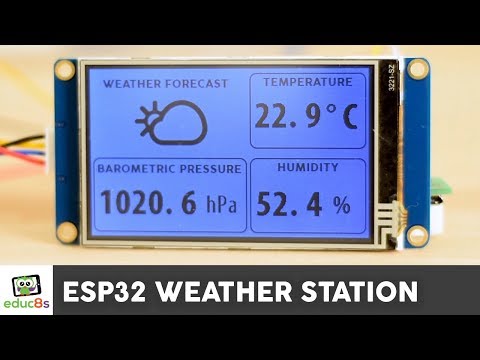
Dear friends welcome to another video!
In this video we are going to build a WiFi enabled weather station project!
We are going to use the new, impressive ESP32 chip for the first time along with a Nextion
display.
Let's get started!
Hello, guys, I am Nick and welcome to educ8s.tv a channel that is all about DIY electronics
projects.
In this channel, I share everything about the projects I build to help you develop similar
projects or inspire you to start making things because it is easy, fun and creative.
Subscribe to the channel now if you do not want to miss any future video.
In this video, we are going to make this.
It is yet another weather station project I know, but this time we use the new ESP32
chip!
We also use the new BME280 sensor which measures the temperature, the humidity, and the barometric
pressure.
When we power up the project, it connects to the WiFi network, and it is going to retrieve
the weather forecast for my location from the openweathermap website.
Then it will display the forecast on this 3.2" Nextion Touch Display along with the
readings from the sensor!
The readings are updated every two seconds and the weather forecast every hour!
As you can see, in this project we use the latest technologies available to a maker today!
If you are a DIY veteran, you can build this project in five minutes.
If you are a beginner, you have to watch a couple of videos before attempting this project.
You can watch those videos by clicking on the cards that will appear during the video.
Let's start!
In order to build this project we need the following parts:
• An ESP32 board • A BME280 I2C sensor
• A 3.2" Nextion display • Some wires
The cost of the project is around 30$.
You can find links to the all the parts I use in the description of the video below.
Instead of the ESP32, we could use the cheaper ESP8266 chip, but I decided to use the ESP32
to gain some experience with it and see what works and what not.
This is the first project I ever build with the new ESP32 chip.
If you are not familiar with it, the ESP32 chip is the successor of the popular ESP8266
chip we have used many times in the past.
The ESP32 is a beast!
It offers two 32 processing cores which operate at 160MHz, a massive amount of memory, WiFi,
Bluetooth and many other features with a cost of around 7$!
Amazing stuff!
Please watch the detailed review I have prepared about the chip by clicking on the card here.
It will help understand why this chip will change the way we make things forever!
Also, this is the first project I build with a Nextion touch display.
The Nextion displays are new kind of displays.
They have their own ARM processor at the back which is responsible for driving the display
and creating the graphical user interface.
So, we can use them with any microcontroller and achieve spectacular results.
I have prepared a detailed review of this Nextion display which explains in depth how
they work, how to use them and their drawbacks.
You can watch it by clicking on this card.
The connection of the parts is straightforward as you can see from this schematic diagram.
You can find a link to the schematic diagram in the description of the video below.
Since the BME280 sensor uses the I2C interface, we only need to connect two wires to communicate
with ESP32.
I have attached the sensor to Pins 26 and 27.
In theory, every digital pin of the ESP32 board can be used with I2C peripherals.
In practice though, I found out that some pins did not work because they are reserved
for other uses.
Pins 26 and 27 function great!
To send data to the display, we only need to connect one wire to the TX0 pin of the
ESP32.
I had to bend the pin like this to connect the female wire of the display since the ESP32
board is too big for this breadboard.
After connecting the parts, we have to load the code to the ESP32, and we have to load
the GUI to the Nextion display.
If you have trouble uploading the program to the ESP32 board, hold down the BOOT button
after pressing the upload button on the Arduino IDE.
To load the GUI to the Nextion display, copy the WeatherStation.tft file I am going to
share with you to an empty SD card.
Put the SD card into the SD card slot at the back of the display.
Then power up the display, and the GUI will be loaded.
Then remove the SD card and connect the power again.
After successfully loading the code the project will connect to the WiFi network, it will
get the weather forecast from the openweathermap.org website, and it will display the readings
from the sensor.
Let's now see the software side of the project.
To parse the weather data, we need the excellent Arduino JSON library.
We also need a library for the sensor.
You can find links to all the libraries in the description of the video below.
Let's see the code now.
At first, we have to set the SSID and the password of our WiFi network.
Next, we have to enter the free APIKEY from operweathermap.org website.
To create your own API key, you have to sign up on the website.
Getting current weather data and forecast is free, but the website offers more options
if you are willing to pay some money.
Next, we have to find the id of our location.
Find your location and copy the ID which can be found in the URL of your location.
Then enter your city's id in the CityID variable.
Also, enter the altitude of your town in this variable.
This value is needed for accurate barometric pressure readings from the sensor.
Now we are ready to move on.
At first, we initialize the sensor, and we connect to the WiFi Network.
Then we request weather data from the server.
We get a reply with the weather data in JSON format.
Before sending the data to the JSON library, I manually delete some characters that were
causing me problems.
Then the JSON library takes over, and we can easily save the data that we need in variables.
After we have kept the data in variables, all we have to do, is to display them on the
screen and wait an hour before requesting new data from the server.
The only information I present is the weather forecast, but you can display more information
if you wish.
It all here saved in variables.
Then we read the temperature, the humidity and the barometric pressure from the sensor
and we send the data to the Nextion display.
To update the display, we simply send some commands to the serial port.
If you get this compilation error while compiling, you have to add this -fno-threadsafe-statics
at the platform.txt file which is located here: … Press save, and then the project
will compile fine.
The software for the ESP32 is not mature, yet so some things do not work at once yet.
The Nextion GUI consists of a background, some textboxes and a picture that changes
depending on the weather forecast.
Please watch Nextion display tutorial for more information.
You can quickly design your own GUI if you wish and display more things on it.
As always you can find the code of the project in a link in the description of the video.
As you can see, an experienced maker today can build exciting projects in just a few
hours with a few lines of code and only three parts!
A project like this would have been impossible to make even two years ago!
Of course, this is just the beginning of the project.
I would like to add many features to it, like graphs, touch functionality that is now missing,
maybe a bigger display and of course a beautiful looking 3D printed enclosure.
I will also design a better looking GUI and icons.
I have some very fresh ideas to implement!
I would love to hear your opinion about today's project.
What kind of features do you want me to add to the project?
Do you like how it looks?
How do you want to see it evolve?
Please post your ideas in the comments section below; I love reading your thoughts!
If this is your first time here, I would love to have you subscribed.
In this channel, I post videos about DIY projects twice a month.
I love making things, and I believe that anyone can make things, anyone can become a maker.
That's why I created this channel, to share my knowledge with the community and learn
from the community.
I hope you will join us.
I will see you in the next video!
[ Translating these subtitles?Add your name here! ]
-------------------------------------------
How to replace rear brake caliper MERCEDES BENZ E W211 TUTORIAL | AUTODOC - Duration: 7:29. For more infomation >> How to replace rear brake caliper MERCEDES BENZ E W211 TUTORIAL | AUTODOC - Duration: 7:29.
 -------------------------------------------
Peace Devotions - Are You Lonely? - Duration: 1:56.
I've been surprised with how lonely life can feel. And you don't have to be on
some deserted island to experience it. Probably one of the loneliest parts of
my life was when I was working in Western Australia. I had graduated from
University and was working on a remote goldmine. I was surrounded by friends and,
from a worldly point of view, I was successful. But I was lonely. It felt like
no one really understood me. No one was truly close to me. No one
really loved me. But is that really true? God speaks to us in Psalm 139 and says
No matter where we are in this
world God is there also and the psalmist says that his right hand will hold us
fast. The right hand is Jesus. Because of Jesus God's presence is a loving one. He
loves us and cares for us. He knows us intimately and will be with us to the
end of our life. He promises never will I leave you, never will I forsake you. So
when you feel lonely, God is there. He loves you because of Jesus. So look to
him and his word. Amen.
-------------------------------------------
How To Add Subscribe Logo In Videos||Create Subscribe Button In Your Video - Duration: 6:26.
Please hit the subscribe button
-------------------------------------------
Discovery Science Theater 3000 - Duration: 1:26.
In the not-too-distant future Next Sunday A.D.
There was a girl named Mike, Not too different from you or me.
She worked on the USS Shenzhou, Just another face in a blue jumpsuit.
She did a good job keepin' up the place, But her bosses didn't like her
So they shot her into space.
We'll send her crummy stories, The worst we can write.
She'll have to go and act them out, And we'll monitor her mind.
Now keep in mind Mike can't control Where the stories begin or end
So she'll try to keep her sanity With the help of her Starfleet friends.
Starfleet Roll Call: Tilly!
Saru!
Paul Stamets!
Aaaash!
If you're wondering how the show fits in and other canon facts,
Then repeat to yourself, "It's just a show, I should really just relax
For Discovery Science Theater 3000!
-------------------------------------------
THE DOWNLOAD | Halloween Games and Wolfenstein 2 With Pixelbitch - Duration: 6:31. For more infomation >> THE DOWNLOAD | Halloween Games and Wolfenstein 2 With Pixelbitch - Duration: 6:31.
 -------------------------------------------
IKEA KIVIK sofa – Together, your way - Duration: 0:26.
Together your way
KIVIK Product Type 00000
-------------------------------------------
LORAC Get Gorgeous Collection - Duration: 4:39. For more infomation >> LORAC Get Gorgeous Collection - Duration: 4:39.
 -------------------------------------------
IKEA EKTORP sofa – Washable, so you can be you - Duration: 0:25.
Washable, so you can be you
EKTORP Product Type 00000
-------------------------------------------
The Most Terrifying Sound You've Never Heard - Duration: 6:10.
hey, welcome to 12tone, and happy Halloween! last year we looked at some of the tricks
that film composers use in order to make horror movies sound scary, but it turns out that
the scariest sounds may be the ones you don't hear at all.
what do I mean by that?
well, let's talk about how sound works.
what we hear as sound is actually just a pressure wave traveling through the air.
our ear picks up the vibrations, and our brain converts them into what we interpret as noise.
these sound waves have two main properties: amplitude and frequency.
amplitude is the difference between the high-pressure peaks and the low-pressure troughs.
that is, it's a measure of how hard the air is vibrating, and we perceive it as volume.
louder sounds create more powerful pressure waves, and we measure that effect in decibels.
decibels are a logarithmic scale: if you double the total sound level, you've increased the
volume by about 6 decibels.
prolonged exposure to sounds over 85 decibels, roughly as loud as a lawnmower, can lead to
permanent hearing damage, while sounds at 120 decibels or higher, like a gun shot, can
cause physical pain.
frequency, on the other hand, is all about the speed of the vibrations.
we measure this in hertz, which is just how many times the wave cycles from high pressure
to low and back to high within a single second.
frequency information is processed as pitch, with faster waves perceived as high and shrill,
while slower waves are low and booming.
actually sound waves are a little more complicated than that, but it's close enough for our purposes
here.
if you've looked at this sort of thing before, you may already know that the octave, our
most fundamental interval, is a doubling in frequency.
that is, if we make the wave twice as fast, it sounds really similar. and the same thing
works in reverse: here's a wave at 320 hertz, which in terms of pitch is somewhere between
a D# and an E in the middle of the piano.
if we slow it by half we get 160 hertz, which is the same note an octave lower . doing that
again gets us to 80 hertz, 40 hertz, and then 20 hertz, and if you can't hear that one,
don't worry.
20 hertz is generally considered the bottom of human hearing.
and it gets worse: not only is it hard for you to perceive it, but there's a good chance
the speakers you're using can't produce it.
manufacturers know that you can't really hear this range anyway so they often cheap out
on making it work.
ok, I'll stop playing the note now.
but even if your speakers can't play it, high-quality subwoofers like the ones used in movie theaters
can.
they can even go lower than that, creating what's called infrasound, because it's too
low to be perceived as sound.
at high enough volumes it does become audible, sort of, but it has to be really loud, it
doesn't carry tonal information, and it can be pretty effectively masked by other, higher
frequencies.
instead, it's mostly perceived as a deep rumbling sensation, almost like a miniature earthquake,
which makes sense because a really loud, really low sound wave is pretty much what an earthquake
is.
that rumbling can cause a lot of anxiety, especially because it has no apparent source.
for obvious reasons, humans like to know what's causing the things we experience.
like, if a large truck drives past you and you feel the ground shake a little, that's
probably not going to scare you because you know where it's coming from.
you don't have to worry because you've seen the truck and you know it's not a threat.
but if you're just walking down an empty street and the ground starts rumbling? that could
mean danger.
that could mean death.
infrasound is thus really effective at building tension before the scare.
studies have shown that exposure to high-volume infrasound can disrupt cortisol levels, which
are associated with stress.
it tells us that something's wrong, even though we haven't actually seen it yet nm. it's like
walking down a dark alleyway in the middle of the night: everything may look fine, but
you don't actually feel safe.
infrasound helps create that sort of environment within the movie theater, where you sense
a looming threat but have no idea where it might come from.
infrasound may even be responsible for more disturbing phenomena.
the resonant frequency of the human eyeball is 19 hertz, just within the infrasound range,
and if you play that frequency loud enough, it can cause your eyes to twitch involuntarily.
if you turn it up louder it can even cause distortions in your vision, as the sound warps
your eyeballs, applying pressure to your photoreceptors and sending signals that your brain incorrectly
interprets as light.
this phenomenon has been blamed for numerous ghost sightings in haunted labs and the like
that turned out to be the result of bent fan blades and other infrasonic events.
it's worth noting here that this is, as far as I could tell, an under-researched field
and that a lot of these ideas are just that: ideas.
in fact, the mythbusters even tested whether infrasound could make a place seem haunted
and came to the conclusion that it couldn't.
however, I've watched the episode and there's one possible caveat I want to point out: volume.
they never give a specific decibel number for the sound they're playing, and they even
talk at one point about having to turn their speakers down to avoid rattling the dilapidated
cabin they're using as a testing site.
given that visual distortions allegedly require amplitudes of 110 decibels or more, it's not
clear that they were actually playing their infrasound loud enough to cause problems.
but while the effects are understudied so we don't know for sure what infrasound does
to the human body, the possibilities are scary.
while shaky eyes and ghostly visions may seem bad enough, the book Acoustic Weapons by Seth
Horowitz details some even more disturbing risks.
after all, the eyes aren't the only vulnerable organ.
at around 130 decibels infrasound can disrupt your inner ear, messing with your ability
to understand speech.
150 decibels causes whole-body vibrations and possibly nausea. and around 170 decibels
the air in your lungs could start to warp, making it hard to breathe and maybe even inducing
artificial respiration as the pocket of air expands and collapses in time with the infrasonic
wave. and, at 240 decibels, with the right frequency, it's possible you could shake a
human head so violently it explodes.
but I wouldn't worry too much about that: at 194 decibels, the wave is strong enough
to create a literal vacuum in the low-pressure troughs, so reaching 240 in order to create
a weapon isn't very practical.
which brings us to infrasound's most famous use: the brown note.
this is a rumored frequency that, when played at a high enough volume, disrupts the human
digestive system and causes you to… well, you know.
however, as far as I can tell, there are no actual documented cases of this happening,
and controlled attempts to reproduce the effect have all failed.
thankfully, it just doesn't seem to be a real thing, at least not at volumes that are otherwise
safe.
but back to horror movies, infrasound is becoming a more common tool as speaker technology improves.
these days a high-end home theater system can pretty effectively produce those lower
frequencies, and as we develop further, generating infrasound in your home is going to get easier
and easier, so expect to hear more of it in the future.
or not hear it, I guess.
you know what I mean.
anyway, thanks for watching! if you want to help make these videos possible, please consider
supporting 12tone on Patreon or checking out our store.
you can also join our mailing list to find out about new episodes, like, share, comment,
subscribe, and keep on rockin'.

Không có nhận xét nào:
Đăng nhận xét